
Serendip is an independent site partnering with faculty at multiple colleges and universities around the world. Happy exploring!

Day 5--"Near-Sighted Visionaries": On Beyond Versus

I. on being lost?
finding the forum?
logging in before posting?
(read through Chapter 8 for Thursday's small group discussions....)


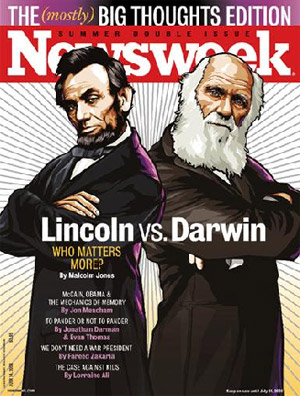
This course differs from Newsweek
in offering "and" rather than "or" relations

--on the question of Lincoln's and Darwin's relative greatness;
--on the question of the relative "worth" of
science and humanities, biology and literature
(applied in departmental mtg. last week!); and
Paul Grobstein's picture

Evolving science/science education

Several years ago, I wrote an essay on science and science education (Revisiting Science in Culture: Science as Story Telling and Story Revising), partly in response to a student who had heard/read some of my thoughts in class and wrote in 2003 ....

Paul Grobstein's picture

"Institutional thinking" and "thinking for one's self": finding common ground

In the 27 January 2009 New York Times, columnist David Brooks writes
"I thought it worth devoting a column to institutional thinking because I try to keep a list of the people in public life I admire most. Invariably, the people who make that list have subjugated themselves to their profession, social function or institution."

Classlist

Anne Dalke
(English House III)
Paul Grobstein

Day 3: On Reading Darwin as a Novelist

What It Means to Read Darwin;
What It Meant for Darwin to Read....


mfradera: What surprised me most about Darwin's work is how many other people he cites.

Ann Dixon's picture

Digg Serendip

digg_bgcolor = '#ff9900'; digg_skin = 'icon'; digg_window = 'new';
Ann Dixon's picture

Bookmark Serendip on deli.cio.us

Paul Grobstein's picture

Thoughts on Obama's "restore science to its rightful place"

Barack Obama is a serious and committed pragmatist, in the best sense of that word, and I understand his inaugural commitment to "restore science to its rightful place" in exactly those terms. What's important about science is not its certainty about ways to act, but rather its willingness to aggressively acknowledge uncertainty, and so to hold to the fire any presumptions about how to act that derive from any source other than clearly defined and commonly accepted observations to date.

Syndicate content
