Serendip is an independent site partnering with faculty at multiple colleges and universities around the world. Happy exploring!

jaranda's picture

Class Notes from Nov. 30

 Doubting and Believing


Our third 4 page paper is due online Friday at 5. Anne would be interested in seeing collaborative papers. 

For Thursday, we should read the first half of Call of Stories, and think about the role of stories in our lives. The book might be a little outdated, but we should compare our stories to his, and think about the role stories play in our lives. 

Cellular Respiration and Photosynthesis – Important Concepts, Common Misconceptions, and Learning Activities

These Teacher Notes summarize basic concepts and information related to energy, ATP, cellular respiration, and photosynthesis. These Teacher Notes also review common misconceptions and suggest a sequence of learning activities designed to develop student understanding of important concepts and overcome any misconceptions.

The attached files describe the key concepts, common misconceptions and suggested learning activities (in Word and PDF formats).

Smacholdt's picture

The Problem with Public Education

 I thought that Sir Ken Robinson’s video that we watched in class the other day was a clever way to convey the problems with education in an entertaining way. The video was creative on so many levels- he explained the issue clearly and concisely, while providing entertaining illustrations that drew the view’s attention to what he was talking about. In addition, the way he “taught” this topic is exactly the way that experts in the field of education say that our brains learn best- though drawing and connected, “idea webs” such as the one that Robinson drew during the presentation.

Where does a tree's mass come from?

4 hypotheses where plant's mass comes from

Students analyze evidence to evaluate four hypotheses about where a tree’s mass comes from. 

Students engage in scientific practices as they learn that trees consist mainly of water and organic molecules and most of the mass of the organic molecules consists of carbon and oxygen atoms that came from carbon dioxide molecules in the air.

For example, students analyze Helmont’s classic experiment and evaluate whether his interpretation was supported by his evidence.

The Student Handout is available in the first two attached files. The Teacher Notes, available in the last two attached files, provide instructional suggestions and background information and explain how this activity is aligned with the Next Generation Science Standards.

Plant Growth Puzzle

This activity has been included as part of Photosynthesis and Cellular Respiration – Understanding the Basics of Bioenergetics and Biosynthesis (available at /exchange/bioactivities/photocellrespir).

Plant Growth Puzzle – Photosynthesis, Biosynthesis and Cellular Respiration

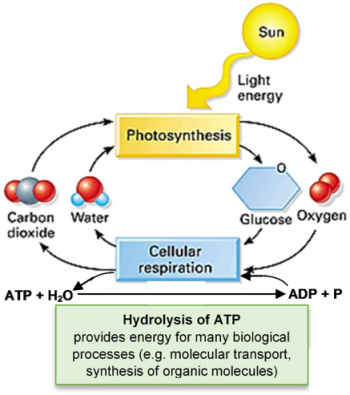
Photosynthesis and cellular respiration cycle with the hydrolysis of ATP

This minds-on analysis and discussion activity challenges students to explain changes in biomass for plants growing in the light vs. dark. Students analyze how photosynthesis, biosynthesis, and cellular respiration affect biomass.

The Teacher Notes suggest three possible additions to this activity that expand student understanding of photosynthesis, cellular respiration, hydrolysis of ATP, biosynthesis, and starch. (NGSS)

The Student Handout is available in the first two attached files and as a Google doc designed for use in distance learning and online instruction. (For additional instructions, see https://serendipstudio.org/exchange/bioactivities/Googledocs, especially item 7.) The Teacher Notes, available in the last two attached files, provide instructional suggestions and background information and explain how this activity is aligned with the Next Generation Science Standards.

Food, Physical Activity, and Body Weight

This analysis and discussion activity helps students to understand the relationships between food, physical activity, cellular respiration, and changes in body weight.

Analysis of a representative scenario helps students to understand how challenging it is to prevent weight gain by exercising to offset what seems to be a relatively modest lunch.

The Student Handout is available in the first two attached files. The Teacher Notes, available in the last two attached files, provide instructional suggestions and background information and explain how this activity is aligned with the Next Generation Science Standards.

Introduction to Proteins and DNA

The Teacher Notes present a sequence of activities that will help students understand the basic structure and function of proteins and DNA.

To understand how genes influence our characteristics, students learn that different versions of a protein can result in different characteristics, and a gene in the DNA determines which version of a protein is synthesized by a person’s cells.

This information is conveyed through a PowerPoint with a sequence of discussion questions and videos, a Student Handout, and an optional hands-on learning activity. This sequence can be used in an introductory unit on biological molecules or to introduce a unit on molecular biology.

platano's picture

Categories in Family Guy

I was watching a Family Guy episode where Brian Writes A Best-Seller. Brian gets upset because none of the "serious" books he has written have gotten any attention. To prove the point that self-help books sell despite the lack of content he sets out to write one. His book "Wish It. Want It. Do It." becomes very successful and he gets to go on many interviews. The first one that he goes on is at a local news-station and the conversation that took place reminded me a lot about my Non-Fiction prose class. The conversation (07:01- 07:40)


AyaSeaver's picture

Who Authored You?

             In my family women are archivists. At the end of the school year I throw a pile of paper into the recycling bin and five minutes later I hear my mother going through it. My grandmother visited us so as not to not to 'miss' moments. She visits it seems to take photographs the event is listed on her itinerary when she sends it. I have received all of the following images at least three times and usually in multiple mediums—from a CD and an email for example. There’s a determination for my Grandmother—who also will sit down and force her cousins to write out what they can remember about relatives and family trees—to make the dead take root in us.

Syndicate content