
Serendip is an independent site partnering with faculty at multiple colleges and universities around the world. Happy exploring!

Motherhood?
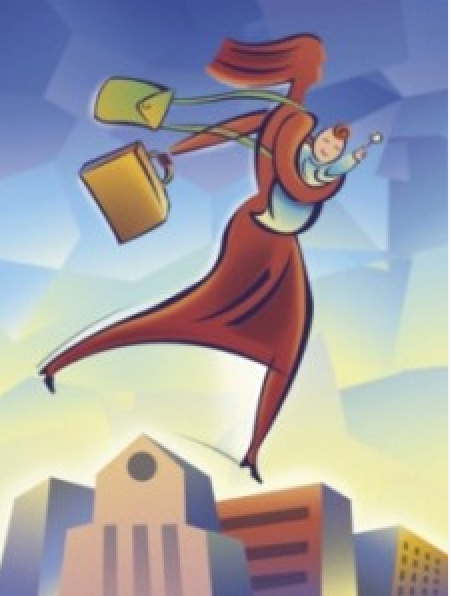
I recently read an article "Motherhood as a Retreat from Equality" (http://www.nytimes.com/2011/08/24/world/europe/24iht-letter24.html?pagewanted=2&ref=feministmovement). It talks how many women go back to work after giving a birth in Germany and France.
Though motherhood seems far in the future, I know it is coming and it's coming quickly. So I asked myself a question. I want to be a doctor. That is one of the reasons to come to Bryn Mawr so I can get eduated well. And, I wouldn't be able to trust anyone to take care of my baby(ies). Then, will I be able to sacrifice my career to be a "full-time mom"? Then, is coming to BMC worth it? Will it pay off someday? Or, would having a baby make me happy?
I have always wanted to ask my feminist friends this question: which one is more important? motherhood or career? Why? If you want to go back to work after having a baby, would you feel comfortable hiring a nanny to take care of your baby? If you do not want to go back to work right after, how long will you take a break from work? And, what makes you believe that the companies still want to hire you even though there will be smarter, younger people who work for them?

Imagine Africa Field Trip Reflection: Healing & an Unforgettable Experience
I have three words: What. A. Week!!!!!!!!!!!!!!!! There are so many things that I want to blog about but I will stick to my incredible experience at the Imagine Africa Exhibit at the UPenn Museum. I’ll do it in two parts:
Part I: I really enjoyed the field trip with the high school teenagers—I don’t think the trip would have been the same without them. My favorite part of the museum was the exhibit that allowed us to “create” Africa or, better yet, to reveal the many “stories” of Africa. Aside from the fact that the exhibit was limiting because you could only “imagine” Africa with the images/words/media clips available, I felt empowered. I felt empowered in the sense that I had the ability to determine whether or not I wanted Africa to be described as “beautiful” vs. “Unique” or “Modern” vs. “Rural.” Of course, Africa can embody both components but having a say in what Africa meant to me instead of having someone impose their views on Africa, particularly in education settings, on me was a powerful moment. My group happened to have the word, “healing.” And although, initially, we thought that there was no healing in the world, or very little, seeing the high school sophomores excited at the chance to define Africa and to make meaning out of her history was healing happening right before my eyes.


Confession
I have a confession to make. In eighth grade, I was first exposed to a documentary called Invisible Children that exposed the longest running war in Africa with all its atrocities. From that point on, being apart of this organization was my life and passion. I felt so enraged that human beings could be treated as animals and slaves in this day and age. I was a founding member of the club in high school as well as at Bryn Mawr where I hosted many fundraisers and participated in peaceful demonstrations on the behalf of the children of Northern Uganda. However, this past summer after six years of involvement, I came to the realization through divine intervention per se that Invisible Children as an organization had consumed me and made me into a monster. Instead of continually being empowered to help children abducted and forced to fight in a terrible war, I was more concerned with receiving the recognition and glory for my good works. The irony in all this is that the initial spark that created this passion for activism came from this deep belief in human rights. I really started thinking about how this passion is connected to the 360 program when Teresa came to our class and asked us why we were in the class or program. Originally, I applied because I had a passion to help from a position of privilege as well as compassion. However, through the 360 program, I no longer see a single story. I had compassion for children that were used for rape as a weapon of war, but I did not allow myself to see the an amazing culture.

A Mumble Jumble of Thoughts
During Thursday's discussion, I had much to say about the education system and how I am perfectly content with the way it is; in fact, I think I was defending the system. I have come to adapt to its ways, and even dare to say that I have mastered it well—enough to know to do what I am told, say what it expected of me, and never question the system. The thought of changing a system that I have successfully maneuvered for the last 16 years of my life scares me. I’m not even sure I want to imagine a world that is any different—where students can freely do whatever they need in order to fully understand and digest material, where the established roles of teachers and students are broken down. Honestly, using the restroom without asking for permission is still something I can’t do in my college classes; I have always known my place a student and never questioned it, just always adapted to this role. But it never occurred to me that other people can’t. I was selfish in my thoughts the other day when I mentioned that in an environment that caters to everyone’s needs, I will be displaced. There are so many people who have been feeling like this for quite a while, and barely anyone to speak up and do something for them.

History/Structure of Ghanaian Education System Sources
“History of Education in Ghana”
http://politicalpola.wetpaint.com/page/HISTORY+OF+EDUCATION+IN+GHANA
“The Educational System of Ghana”
http://ghana.usembassy.gov/education-of-ghana.html
“Higher Education in Ghana”
http://www.ghanaweb.com/GhanaHomePage/NewsArchive/artikel.php?ID=160902
“A Brief History of the Ghanaian Educational System”
http://www.tobeworldwide.org/index.php?option=com_docman&task=doc_view&gid=4
“Ghana Education System”
http://yfughana.webs.com/ghanaeducationsystem.htm
“Evolution of the Educational System in Ghana Since Independence in 1957”
http://www.uew.edu.gh/index.php/our-offices/office-of-the-vice-chancellor/137-past-vice-chancellors/prof-jophus-anamuah-mensah/prof-jophus-anamuah-mensahs-speeches/83-evolution-of-the-educational-system-in-ghana-since-independence-in-1957

interdependence
I’ve been thinking about how useful it is to have so many different majors present in this literacy class and 360 - In a discussion on Tuesday in Psych, many of us were really confused about how to proceed with the unfamiliar psychology terms. But Manya was able to give us a really good explanation - we kind of drilled her for information! Also, Lucy and I were talking about her background in Anthropology this morning - this will be useful in our explorations of culture.
We are a community of many different skill sets - and we can benefit from all of those disciplines when we are open to learning about and from each other. It’s really difficult to ask for help - especially when (often) our previous education calls for independence and individuality. However, knowing your resources and using them effectively - that does not imply dependence, but a kind of fusion or interdependence.

BMC Libraries Appreciate Gender Diversity
So I was taking a survey sent out by BMC's library services, and I just wanted to publicly appreciate their acknowledgement of gender diversity.


Remote Ready Biology Learning Activities

Remote Ready Biology Learning Activities has 50 remote-ready activities, which work for either your classroom or remote teaching.
What's New? Subscribe to Serendip Studio
A Random Walk
New Topics
-
1 week 9 hours ago
-
1 week 9 hours ago
-
1 week 9 hours ago
-
1 week 9 hours ago
-
1 week 3 days ago
