
Serendip is an independent site partnering with faculty at multiple colleges and universities around the world. Happy exploring!

A Betrayal by Definition: Black Feminism Manifests Itself (Or Doesn’t) in the American Experience
To purpose the ambiguous wanderings of my forming identity, I must first name myself. By associating with resolute terms I mean to say I commit to them, taking both the burden and the pride of my self-claimed appellations, determinately thrusting myself under the weight of them. Inextricable from these things, they are a part of me. I take on their responsibility, actively challenging the connotations of those labels as I perceive them while also bearing in mind how I am perceived by outside of myself. I name myself a woman, resolutely. I name myself a feminist, resolutely. I name myself my mother’s daughter, resolutely. While I have been able to immerse myself in struggling with these few realms of self-discovery, troublingly, what I struggle most with is to claim my name as a Black woman.

The Veil (as told by the girl who bought a copy of The Complete Persepolis for $15 on Amazon.com)

Is this working? #IrefusetosayTweet
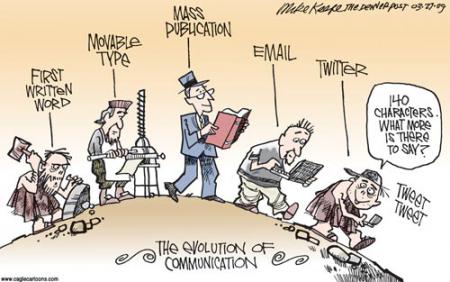
In case anyone missed what my face looks like when we discuss Twitter in class just picture a child in a sauna who keeps going outside to get ice cream, bringing it in, and watching sadly as it melts for the seventh time in a row. I go through these phases with Twitter, I think I vaguely get it, I get a little excited because I (kind of) know what's happening, and then I log on and see a massive jumble of tiny snippets of conversations I can never catch up on with a thousand links that send me all over the place and I'm back at square one. I think part of the reason I am so bad with Twitter is that I don't like it. That is my main point and already I would have used about three or more Twitter posts to say it, unless I simply wrote "I dislike Twitter and suspect it is mutual". I grew up in a house with more books than furniture, I've always read the book before the movie, and I still prefer to thumb through giant reference books for information. I am not built to sum things up succintly (as you have probably guessed by now).
world travel/ perspective
This image is from an episode of West Wing, where people bring in a map of the world that is upside-down and explain why it changes everything. The initial reaction, of course, is to laugh because it's such an odd idea and seems so trivial. However, once I began actually looking into this after our class discussion of "world travel" and perceptions, I realized there is actually something to it. For one thing, the continents are re-sized more acurately, but also it does make you think about the relationship between North and South and Top and Bottom. Even if you don't realize it, I certaintly didn't, constantly seeing the US as near the top of the world, or at least above other countries on the map has an implication of power and importance. Imagine if we were no longer North America, but South? Besides the fact that it sounds weird, are there any other reasons we would object?

Single Story
While listening to the TED talk I found myself both agreeing and disagreeing with this idea of a "single story". Initially I agreed because frequently there are single stories or party lines that get fed to us and when you actually research the topic you find out that there were a million other voices that got ignored in favor of one idea. However, it was that thought that made me question the conclusion even as I came to it. Is an idea a "single story" of sorts? When you hear an idea or story don't you automatically internalize it in one way or another and make it different? Even if it's just the difference between laughing at something or not, or agreeing with a statement or remaining silent--doesn't that change the way other people see it (or hear it, read it, etc.)?

Silence and Good Intentions
On Thursday I worked with a student on her college essay. She asked me to read it over and provide feedback. After reading the first paragraph and skimming the rest I immediately thought this won’t do. Her story was not compelling enough and did not highlight her agency. In addition to the missing “wow” factor it lacked an inviting introduction and presented no hard-hitting obstacle she overcame that communicated her resiliency and strength. It failed to do what I was told a “winning” essay would do, which was, captivate an audience by telling a story. In trying to help improve her essay I immediately went to my email and began sifting through my inbox to find samples of college essays given to me during my junior year as well as my own “mission statement” for her to use as a guide. As soon as I opened up that document for her I regretted how I was handling the situation.

Literacies - Post 3
When Freire discusses how learning becomes “techniques, naively considered to be neutral, by means of which the educational process is standardized in a sterile and bureaucratic operation” I step back to analyze what goals public education has and how these goals have been sterilized. I question what the intent is for public education today. Pressure to perform on standardized tests are causing the classroom to be centered around the test. But what are the goals of the test? One could argue, such as myself, that tests funnel students into reproduction of socio-economic class status. Tests do seek to also gauge whether a student has mastered certain material. To use standardized tests to judge whether a student knows how to read then makes literacy a standardized and sterile activity. Centering a classroom around the assessment tool does not provide in-depth experiential education on a topic. As educators I believe we should focus on the goals of the tests not on the tests themselves. How can we shift the focus off high-stakes testing when salaries, school funding, and schools remaining open depends on test results? How can our students be successful on tests without us teaching to the test?

Remote Ready Biology Learning Activities

Remote Ready Biology Learning Activities has 50 remote-ready activities, which work for either your classroom or remote teaching.
What's New? Subscribe to Serendip Studio
A Random Walk
New Topics
-
1 week 10 hours ago
-
1 week 10 hours ago
-
1 week 10 hours ago
-
1 week 10 hours ago
-
1 week 3 days ago
