
Serendip is an independent site partnering with faculty at multiple colleges and universities around the world. Happy exploring!

A Wall of Dragonflies
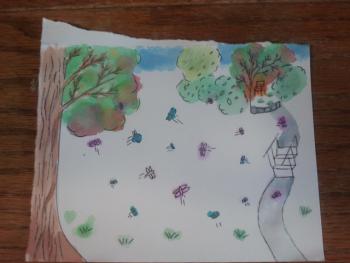
There is a wall of dragonflies preventing me from getting to my destination. I'm letting them prevent me.
I have never seen so many dragonflies in one place and I don't like it. It is amusing how I depicted the dragonflies in beautiful jewel colors when I really don't like them at all. Below is my watercolor from my experience.

What is "recovery" and who is it for?
As I began reading Chapter 4 of Offending Women I was both worried and happy about the different approaches the staff had toward how to help the women in their facility “recover”. I was worried because if these differences led to constant disagreement and distrust between the staff members this would be apparent and hurtful to the women in Visions. However, I think it is helpful to have different perspectives and approach to recovery. The goal of recovery is something the staff seems to agree on: “In short, Visions’ discourse of recovery offered a clear, easy-to-follow interpretation of the inmates’ problems: low-self esteem led to addiction, which then led to even lower self-esteem. It also led to a clear easy-to-follow model of treatment: reflection and introspection heightened self-esteem and thus ended addiction”. This statement makes me think of the language and separation between different types of crime and offenders. For example, is the recovery model also applicable to white collar criminals? My personal instinct says no because I question whether the prerequisite of low self esteem applies to these criminals (do they need to improve their self esteem and recover from greed for instance?). But this question also makes me uncomfortable about the language that is used in some case to discuss offenders who have had less privileged lives.

The Garden 3
It has rained and the garden is very wet. There are no crows. The only sound is a damp thickness of cricket sound, thick as an invisible soup through which my ears have to wade. As I become accustomed and tuned in to them, I hear they are not just an undifferentiated "them", but a symphonic multitude, a chorus of legions of crickets under blade and under leaf, under bush, and under tree. I will search and perhaps find none. I have searched before. Their communication ( I believe that we can make that assumption) has a comforting effect on my nervous system. Theirs is a soft blanketing sound, an unobtrusive blend with the soft swish of leaves in a soundless breeze. We hear the air’s effects. The effect of its movement on surrounding things. Everything is connected. Everything has an affect on something, or someone else.
I have heard myself claim to myself that if a garden sound is not beautiful, in the sense to which I have become accustomed by small song birds, then I would prefer it to be unobtrusive. That is to say banished.
Do I prefer unobtrusive people? Unobtrusive plants?

Site Changes

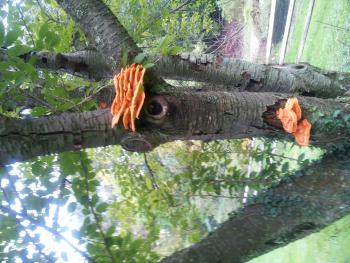

 To begin with, I was so busy emailing the photos to my email so I could upload them, that I thought my assignment was done. I didn't realize that I didn't actually post anything until after my job at the library, I apologize for being late :(
Changes! So many! I dedicated today's observation to seeking out any changes occurring in the area. I could see from very far away that there was an orange growth on the tree I sit under. It was so bright orange, I thought maybe it was the foam that is put to block out and exterminate bee hives. As I got closer, I thought someone might have left a handkerchief tied on the branches. Then I saw this:

Here's the article
...that HSBurke referenced in class today, as we were discussing what to "do" with stories of trauma:
Zimbabwe teen leaves anguish behind, starts future at Bryn Mawr (Philadelphia Inquirer, Oct. 2, 2012)

Article
Hey guys,
Here's the article I was talking about in class today (or rather a link to it from Bryn Mawr's website):
Something about it just rubs me the wrong way. People (even JMac!) are speaking about her with such authority, like they know her so deeply. And it's been, what? a month? I think her story's incredibly brave, but I think what I was trying to get at today is that: as a student body, do our perceptions/treatment of her change thanks to this new knowledge? What do we do with her story?

Rhoads Pond Impressionism

So I am not the best artist in the world, as evidenced by this watercolor. However, I really wanted to use the tools Nan put at my disposal. I found, though, that the brush was not the right instrument for me. I ended up using my fingers to create this. It made me feel much more connected to the paper, and was much eaasier to mix the colors I needed.
I also decided to paint ontop of a page of Gary Snyder's essay. I loved his garden metaphor for good writing, and wanted to incorporate it somehow. I tried painting on just a regular piece of paper, but decided it didn't quite caputer our class notions of language and reprsentation. I'm not quite sure how it connects, seeing as I was painting and not writing, but I like the way it turned out.

needs?
The section of Offending Women made me really angry. I had been angered before at some of the problematic aspects of both the programs that the author was assessing but this chapter struck me as particularly problematic. Many of the practices that were to get women to “open up” seemed almost like some kind of psychological torture, forcing the inmates into hysteria without any real way to build them back up. I was disturbed by the way in which the social aspects of their traumas/stories were ignored to draw focus on the ways in which their “addictive” personalities led to them being imprisoned… It seemed almost violent to the minds and hearts of these women to force them to relive their stories and then place the blame entirely on them for their situation. I was also really angry when Haney was describing the search through the women’s belongings. There was a complete lack of boundaries and privacy, both of which I think people are entitled to. Especially when they went through the women’s things and threw out what the institution had decided were not “necessities.” One of the women had saved up shampoos and toiletries for when she leaves; probably knowing full well what its like not to have money and no access to those things. The staff member cleaning out her room laughed. She laughed, without even bothering to address why that inmate would’ve felt that she needed to stock up on toiletries in the first place.

One woman's freedom is another woman's imprisonment
The description of the Visions community in chapter 5 is reminding me in ways of the Delpit article because it displays the ways in which a liberal, middle class, white agenda about personal growth and well-being can actually be incredibly harmful due to the ways it clashes with the realities of systematic oppression. The ways that the staff people thought of themselves as “liberating” the women, by telling them they couldn’t wear makeup or sexually revealing clothing, when in fact, that is one perception of freedom oppressing these women’s ability to control the external expression of their identities.
This also makes me think about intentional communities in general -- and when and why they work and fail. This seems to produce evidence that, if an intentional community is established, and you bring in and subject others to the intentions of that community who are not devoted to the ideals, but rather are prisoners of those ideals, it becomes another form of incarceration, even if it’s more “humane” according to middle class standards.
“I looked at her and realized that she wasn’t the same woman who entered [Visions] a year ago. This time she couldn’t make it but maybe next time she will… My job is to make the women aware of their psychological pain. She’s aware of it now. So in some way, it was a kind of victory” (176).

Unveiling Prison Employees Too!
When I heard that the Warden was not coming to our class, I was extremely disappointed. Much like the invisibility of prisoners, I feel like the people who work within the system are also invisible. Although I wasn't expecting hirer to share a personal anecdote from her life beyond the prison walls, I did want to see a face and notice the impact it would have on me. When discussing "female offenders" in class, I sometimes forget that the people who must "deal" with them are prisoners as well--they are confined to watching the inmates, confined to possible, and justifiable, fear for their lives every day at work, and, like Tamika from Visions, confined to being an emotionless being. Although Haney gives voice and insight into the lives of the Vision workers, only on the job of course, I also see that even with visibility, Haney was able to capture reservation from the workers. For instance, Tamika did not believe in being emotional while Margaret distanced herself by taking advantage of the power she had over her employees. So it seems that the issue is two-fold: prison employees are invisible from society but at the same time choose invisibility. I wonder if I would have sensed this with the warden and what kind of questions would have come up as a result. Like we do with the inmates we read about, I would like to have a conversation about the ethnic/racial/class make-up of the employees.

Remote Ready Biology Learning Activities

Remote Ready Biology Learning Activities has 50 remote-ready activities, which work for either your classroom or remote teaching.
What's New? Subscribe to Serendip Studio
A Random Walk
New Topics
-
6 days 9 hours ago
-
6 days 9 hours ago
-
6 days 9 hours ago
-
6 days 9 hours ago
-
1 week 2 days ago
