
Serendip is an independent site partnering with faculty at multiple colleges and universities around the world. Happy exploring!

Voice Paper
Through the process of research professors are able to enter an academic conversation with goals that range from solving a social problem to giving voice to particular communities. Interviews, surveys and participatory observation serve as channels that seek to deepen and broaden our understanding of certain groups of people. What is done with the results of months of data collection can range from a change in policy, to simply sharing the findings with other academics. What happens when research is conducted, policy does not change and communities are left “damaged”? By using Eve Tuck’s desire-based research, I will explore the ways in which research can either give voice to or silence communities. Are researchers truly giving communities a voice, even if the act of research is simply a representation of their stories? Who is listening to these voices besides the researcher and the academic community? What is the purpose of research if voice and/or change are not outcomes?

Therapy as Trauma
Haney's discussion of Visions tempted me to compare its problems to those of Alliance. Which was worse? Which group of women had more problems due to the instution's model of rehabilitation? I'm not quite sure why I felt so inclined to compare the two, as both had unique "visions" to make a rather unfortunate pun. Perhaps it's because when it comes to incarceration, we want to choose a model that does less harm than the current punitive role of most institutions. It's difficult to decide what "less harm" actually means--is it short term or long term? I worry that so many of these reformers with good intentions, similar to those who created ESP, seem to only create models with a set of unique challenges. The experience of being in a cage for hours is traumatic but so is the experience of being forced to share intense traumas with an audience. Like after reading Rigoberta Menchu's testimonial, I don't know quite what to do with the information I learned in Haney's book. I used to think that alternative models of incarceration were "the answer" or at least an answer, but I'm no longer so sure that they're actually better than prisons..

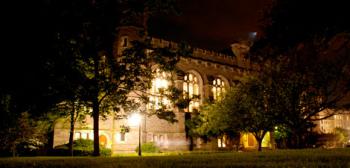 I walked it at night. This big, aesthetically beautiful place becomes something entirely different when it's travelled in the latter part of the day. For days I had been trying to "schedule" the walk, thinking I'll do it between such and such class, before dinner, and so on. But this didn't work at all, because while beginning the walk, all I could think about was how I might be late to work, or late to some other obligation. I wasn't able to clear my mind and just amble. So I finally hit upon it at the time when I usually feel most relaxed and clear-headed: night. It was one of those long days, and after dinner, I just did not want to go back inside my room, I had been inside too much all day, and the spontaneity I had been trying to find in my choice to do the walk was finally in front of me, as I walked straight past Rock Arch into an amble up the curve of the hill near Thomas Great Hall.
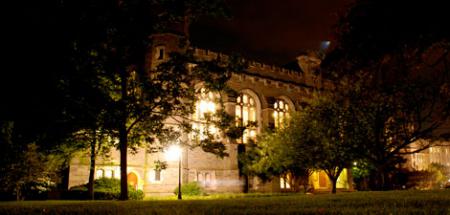

native...weeds..organic
Circulating in the English Department just now is an essay that just appeared in Inside Higher Education: Humanities in the Digital Age. It seemed to me to intersect quite intriguingly w/ the piece by Thomas Berry which we're reading for Tuesday, and the language is quite amazingly (ironically?) 'eco'--for instance, the claim that
"It all starts with where scholars live and work natively: in their departments…Currently, digital initiatives …spring up accidentally like weeds [well, Michael Pollan will soon have something to say to us about that conceit!] around particular faculty, areas, or projects. We propose an organic strategy for integrating digital initiatives into core departmental research, teaching, administration, and staff work…."
this invitation
...for a structured program of "storytelling integrated with mapping" caught my attention. We are not engaged, in this class, in "digital learning" on anything like this scale, but I do think our two small field trips upcoming--"back in time" to the farm from BMC was made, and then "further back in time" to understand the geological formations on which our cultural explorations sit--are akin to this project of "telling the historia of the environment":
Please see below for information on a NITLE webinar that may be of interest. I will be arranging a group viewing here on campus; please contact me if you are interested. You can also register and watch from your own computer using the link below. (Bryn Mawr College is a member of NITLE.)
*****
Stories of the Susquehanna: Digital Humanities, Spatial Thinking, and Telling the historia of the Environment

"Have Spacesuit- Will Travel"
I wrote my first web event for this course in iambic pentameter. It is pastoral, romanticizing the passing of time, the activities of nature, and my place in it. Anne questioned my use of a “very conventional poetic form.” For one I like poetry and I like that it can paint a picture without having to have me in it as an active character- I tried to make my voice more passive. It also seemed to me to be structured, like our assignment of the walk was, yet also fluid and wandering, like the walk was. Perhaps I used iambic pentameter to foreshadow our reading of Mentz on Shakespeare’s ecological tongue; or perhaps I simply did not have the words.
Having read the theories and ideas put forth by so many authors on what an ecological tongue or literary style might be, I now have some new tools with which to experiment in my imaginings of the ecological.
Let’s see what comes out when I try a retelling of my walk in a sci-fi mode…
FIRST TELLING
Where weathered rock and flowing water meet
When hot, moist air retreats at summer’s end;
Above, the vivid boughs do speak of fall
While underfoot the earth prepares for sleep.
The sparrow hops upon the iron rail
While under trees cicadas speak their death.
SCI-FI TELLING

male feminist impressions
I don't know if anyone from our class is still posting here but I saw this and thought of our class and the discussion of male feminists, and societal views of them as kind of awesomecoolwow look at you being a great person, compared to more negative views of female feminists http://amajor7.tumblr.com/post/31102777716/double-standards-are-weird-and-these-look-like

Dance and Technology
Hello everyone!
So, one thing I love more than ANYTHING is when my classes overlap, and that happened to me today with my Computer Science class and this Education class. We had a speaker come in today and talk to us about incorporating dance and technology. Somehow, I managed to bring up Clark's cyborg reading and it fueled part of the discussion about how people "felt" about technology beign incorporated into their bodies and movement. The answer in short is apparently dancers LOVE it! They feel it enhances their capabilites.
I just wanted to share that!
On being rural and queer
In light of our "environmental" interpretation of Bruce Bechdel's life, I thought you all might be interested in an article from yesterday's NYTimes, We're Here, We're Queer, Y'all, which describes the possibility and reality of queer life in rural areas...

What if the plan doesn't work?
Last week, we had an activity, figuring out several polices that explore the problem of female offending problem and address the problem.
It was hard to decide which role at first place because honestly I am not familiar with the system and don’t know anyone in that system. After we finally decided that we will be policy maker, all the policy seems really unrealistic. However, even though the problem seem difficult to deal with. We still need to figure out something to deal with it because we not suppose just wait and do nothing before things get worse. Therefore, we figure we should have a big goal, such as eliminating the poverty.
Ironically, even though this is the goal of generation of human. No one has accomplished nor does anyone have figure out a way to reach that destination. Neither communism nor capitalism had this figured out. However, the direct correlation between the crime rate and poverty is undeniable. The reality in this society is already very cruel for common people. At the same time, for people with come criminal record, life is even hard. It might sound mean, but the truth is that their lives barely go back to normal again. Also, no matter how feminist claim the progress they made to change the unequal situation for women in society. Women are still in disadvantages place. Therefore, these offending women really got them in an unfortunate place to live. Alliance or Vision both tried, but didn’t succeed in some sense.
There are several problems that attract my attention in this problem.

Remote Ready Biology Learning Activities

Remote Ready Biology Learning Activities has 50 remote-ready activities, which work for either your classroom or remote teaching.
What's New? Subscribe to Serendip Studio
A Random Walk
New Topics
-
6 days 8 hours ago
-
6 days 8 hours ago
-
6 days 8 hours ago
-
6 days 8 hours ago
-
1 week 2 days ago
