
Serendip is an independent site partnering with faculty at multiple colleges and universities around the world. Happy exploring!

Consciousness
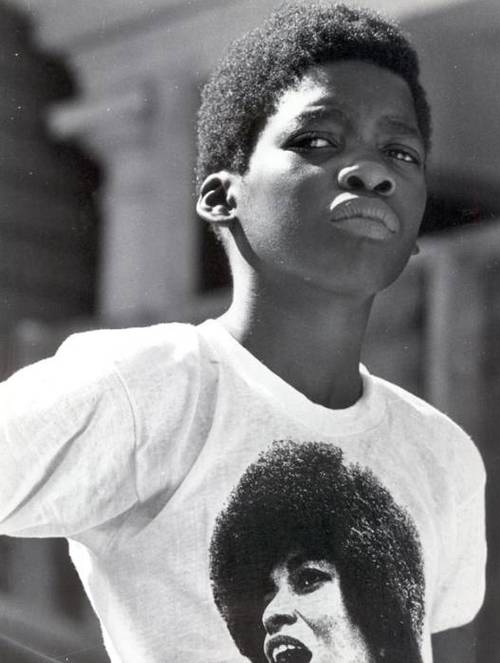
I posted the picture below because I was introduced to the Prison Industrial Complex by learning about Angela Davis. Every time I think of prisons I can't help but think of her movement and her books. I also think that the fact that a black boy is wearing a shirt of her speaks to the facts we've been learning in class about the incarceration of black bodies and the inability of schools to respond to their needs. However, this guy perhaps has some consciousness, I see him as a direct contradiction to a system that wants him to fail. By wearing an Angela Davis shirt, he is speaking his consciousness and at the same time standing for those who like him that have been chased by the prison, schooling, etc. system.

starting with what we need.
In my education class, one of our weekly assignments is to listen to a recording of a group of high school students talking about teaching and learning. The dialogue I just finished listening to seemed very related to the conversation we had in class today about Berry’s proposed college curriculum. His writing communicated to me that he had no understanding of what many students need to get from school. For example, in class I wrote: “for me, all signs point to a job with health benefits and a 401K. This curriculum probably wouldn’t get me that.” I so appreciated hearing what these high school students had to say about what they wanted/needed from school because it provided relief from Berry’s esoteric text. Here are a few quotes which I found particularly shiny. The prompt was: What do you want to see in your classrooms?

Transformative pedagogy
As many of you know, I missed class this past Thursday and Friday to go to the annual Peace and Justice Studies Association meeting, which was being held at Tufts. The whole conference was really great and picked up on so many themes that we’ve been discussing in all three classes. In particular, a session called “Living Our Way Into the Answers: A Workshop on Transformative Pedagogy” really tied in to what we’ve been doing in class. The workshop was really interesting because out of the 30 or so participants, it ended up being split relatively evenly between students and professors. So, while much of the conversation about what transformative pedagogy means for students echoes the things we’ve been talking about amongst ourselves, hearing the teacher-perspective was really fascinating. Beyond the obvious conversation about how to introduce radical pedagogy in a system obsessed with learning objectives and outcomes was the emotional drainage many professors felt – like they just didn’t have the energy to be “transformative” anymore. This is something I haven’t really thought of in terms of my own professors or my friends who aspire to be transformative teachers one day. I also talked about our 360, and got a lot of questions from interested professors about what it’s been like.

Campus Talk of Interest
BRYN MAWR COLLEGE
Department of Sociology
Announces the Upcoming Public Lecture by
WENDY GRISWOLD
Bergen Evans Professor in the Humanities
Professor of Sociology, Northwestern University
The Hand and the Garden: Reading, Connection, and the Five Dimensions of Media Practice
"Have you ever wondered about the impact of the internet on the reading habits of young people?"
Educators and parents worry that reading is faltering among youth, losing the competition with social media, texting, and online entertainment. Past research suggested a “glamour versus honor” thesis. Now research on a new generation (in media terms) finds that although the spatial and temporal organization of connectivity has changed radically, the cultural separation of reading from being online persists. Understanding media practices requires a five-dimensional conception that incorporates space, time, materiality, social honor, and the imagined future.
Thursday, October 25 @ 7:30 p.m., Dalton 300
Open to the Public

Educational Debt: What is specifically owed?
For two days now, I have been thinking about the term, "eduactional gap" mentioned in Girl Time. I think it is a more accurate term than the acheivement gap. I have always disliked this term because it implies that this gap, which never seems to closes, is the fault of the students who are "low-acheiving." It implies, much like in Haney with the female offenders, that it is the responsibility of the student to make up the difference. I used to be all for individualism, which Meiners mentions, but now I see how our society's mindset on individualism can obscure reality and make people believe that the conditions of their lives, good or bad, are a result of their own actions...or lack of action. When, in fact, systems of oppression play a huge, and yet distant, factor in everyone's lives whether to an advantage or disadvantage. I 100% agree that the gap in our education is actually a collection of overdue debts, particularly to inner-city youth. However, as I write this, I am not sure about what exactly is owed us--yep, that includes me--to succeed. What kind of reformation needs to happen? And is it the responsibility of the students who are negatively impacted by the "gap" to make change? This debt that we speak of is more than money, it is SO big--it's like asking to undo the history of racism! This seems highly impossible even though I really want to be optimistic.

Will I Get a Job? : An Exploration Of The Boundary Between Virtual And Meatspace Lives.
Wanting to produce a paper multimodal, I turned to our syllabus for inspiration. Taking elements from the work that we did with scrapbooks, as well as the "roaming ethnographers" exercise, I have come up with this project. To view all of my posts that relate to this paper, click on the EDUC255 hashtag. (You should see it on the first post!)
My intention with this project was to challenge the method in which academic papers were presented. My approach placed more emphasis on the process of thinking through my ideas and thus, I have intentionally refrained from constructing any sort of "academic claim". Further, in the same vein as the "roaming ethnographer" exercise, I posted throughout the weekend as new thoughts came to me. Armed with my iPad, I captured and collected what I call "digital ephemera" -- items that I found floating around in cyberspace/digital representations of "meatspace" objects, that pertained to my key terms: "online identities", "privacy" (or lack thereof), Clark's term "intrusion", "workplace", "Facebook", "professional", and "employment". Using Tumblr seemed the obvious way to go for me; I regarded it as somewhat of an online scrapbook.

Thoreau Children's Story
Henry Takes a Walk: A Thoreauvian Storybook
Written by: Emma Thorp
Illustrated by: Sara Gladwin
Henry began to walk at the top of the long hill above the pond. Directions and destinations were not on his mind. He decided to see where this grassy slope would lead.
Henry wandered along side the pond’s banks, wondering where the ripples came from below the surface.
Several flat, gray paths lead him to a white house hidden among a green jungle. Instead of going through the front door, he followed a steep slope down to a small, muddy bank by a trickling creek.

Someone was leaning over the creek, watching the water skim over the slippery pebbles
Henry knelt down beside Someone, as they stared at the water’s clear surface. They wondered where it came from, and where it was in such a rush to get going.

sit spot.
I usually visit my sit spot in the mornings. I only lasted a little while today...I came out of the woods and wrote! a poem?? I haven’t written a poem since the glory days of acrostics in elementary school. weird. All this talk about words must be rubbing off on me.
That year,
when I leaned against your trunk
and felt your rough bark in my back

Prison and School Across Music, Television, and more
http://www.youtube.com/watch?v=v7gV5C5mB7A
http://www.youtube.com/watch?v=OG3ieifrqyQ
http://www.youtube.com/watch?v=Sw9DADUh490
http://www.youtube.com/watch?v=sBg7AqXRwqg
http://www.youtube.com/watch?v=kR2wfLyT-b0&feature=related
http://www.youtube.com/watch?v=1GZZ13rJsus
http://www.youtube.com/watch?v=Mb1ZvUDvLDY
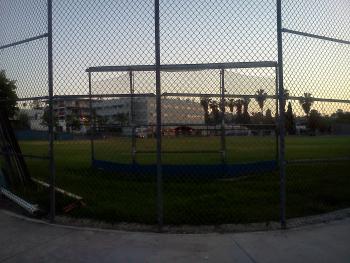
This is my high school. To give you a picture of how many kids were housed in this school here is following statistic: My graduating class was over 500 students. This does not include students who didn't quite make the cut and all the rest of the school population.
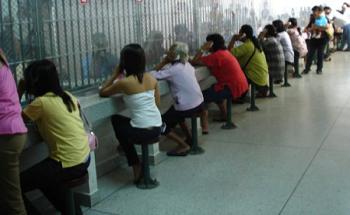
Visiting hours in prison.

"But look at me, I got away"
As I'm reading pages 26-27 in Brothers and Keepers, I could not help it but to pause and write. The part where he begins by writing, "The problem was that in order to be the person I thought I wanted to be, I believed I had to seal myself off from you, construct a wall between us" (26). This line really struck me. Although I am still trying to tie this theme/topic to silence, I'd like to reflect a bit on what he continues to say as he writes.

Remote Ready Biology Learning Activities

Remote Ready Biology Learning Activities has 50 remote-ready activities, which work for either your classroom or remote teaching.
What's New? Subscribe to Serendip Studio
A Random Walk
New Topics
-
6 days 7 hours ago
-
6 days 7 hours ago
-
6 days 7 hours ago
-
6 days 7 hours ago
-
1 week 2 days ago
