


Serendip is an independent site partnering with faculty at multiple colleges and universities around the world. Happy exploring!

Notes towards Day 7

Notes towards Day 7 of Food for Thought

I. Coursekeeping
naming:
who's game?
posting:
Anna, Steph?
reading:
(ignore the pps. re: caterpillars making choices--
the caterpillars aren't ready yet! Wil Franklin is growing them,
will come in two weeks...)
read Lisa Belkin's "02 NYTimes essay on coincidence--
like today's readings, about the tendency of all of us
to look for patterns where there may be none
writing for Friday:

Notes Towards Day 7

Finishing Middlesex/
"Thinking About What Was Next":

Notes Towards Day Seven of

Critical Feminist Studies


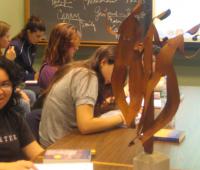
Photograph by Simran Kaur, BMC '04
I. Coursekeeping
naming gaming: 3 to your left, 3 to your right
signing in

Categorization: An Exercise

The result of asking

What categories do each of us occupy?

How might we self-organize into a
taxonomy that makes sense of those identities?
(an exercise in Critical Feminist Studies, 9/18/08):

Two ven diagrams, a tree, a river, and a map
tracing actual and imagined travel trajectories....

Notes Towards Day 6

Finding Ariadne's Thread in Middlesex (Book Three):
Notes Towards Day Six of
Critical Feminist Studies


lrperry's picture

No more universals

Isaiah Berlin in his essay “The Sense of Reality” claims that novelists are better able than scientists to delve beneath the surface of human consciousness and private feelings. Because novelists seek understanding rather than knowledge, they are able to deal with particulars instead of searching for universals and larger systems. I think Grobstein’s lecture walked this line carefully, between avoiding generalizations and attempting to share facts with our class. Rather than stating a definition of sex and gender (as many former professors and high school teachers have done to us – “sex is the bits. Gender is
lrperry's picture

The Outsiders' Society (Page 106)

I am interested in the tension in Woolf’s letters between positions of insider and outsider status in society. On the one hand, Woolf points out that women (or, as she is very explicit to specify: “daughters of educated men”) are less able to create change because they do not hold the traditional positions of power in society. She writes, “All the weapons with which an educated man can enforce his opinion are either beyond our grasp or so nearly beyond it that even if we used them we could scarcely inflict one scratch” (18). Yet, on the other hand, Woolf also suggests that it is this very outsider status that allows these women to effect more meaningful change. “We believe that we can help you most effectively by

Attending to "Choices and Constraints"

Participants in the Fall 2008
Conversations @ Bryn Mawr College
about Choices and Constraints

Syndicate content