
Serendip is an independent site partnering with faculty at multiple colleges and universities around the world. Happy exploring!

Lynn's picture

Lynn's Introduction

 Hi. My name is Avery but I'm going by my middle name here, for whatever reason. I'm in the second semester of my freshman year, and am thinking of majoring in Math and/or Spanish. I moved to Washington (state) after living in Texas for about seventeen years. I'm not currently in any clubs, but am thinking of joining one or two, if only I can learn better time-management. I want to take this course because, while science is not exactly my "thing", I'm fascinated by evolution, and have never seen the subject approached in such a way before. I have three dogs and live on what passes for a farm. In my spare time, I like to doodle and write.

ckosarek's picture

ckosarek's introduction

 I'm a junior English major and psychology minor at BMC, headed toward a post-bac program upon graduation. I run XC in the fall and live for skiing and ski racing in the winter. I like to say that I'm a fact-based English major in that most of my English papers involve a lot of outside research (usually of a psychological nature), which I combine with whatever we're reading or doing in class. I also like to say that I'm on a "need to know" basis with the world; I'm constantly curious, always intrigued, always looking for a good conversation.

ewashburn's picture

Introducing Erin

 My name is Erin Washburn (obviously). I'm a sophomore English major at Bryn Mawr College, working on declaring a theater and classics double-minor. Classes that I've taken and enjoyed during my time in the Tri-Co include Culture and Crisis in the Golden Age of Athens (at Haverford); Tolkein, Pullman and their Literary Roots (at Swarthmore); and Women Poets: Giving Eurydice a Voice (at Bryn Mawr). Though these course listings may seem like I've used my college experience to reject all science-y things, I've always had an interest in biological evolution, and have been interested in taking this class since I was a senior in high school. With regards to what questions I bring to this class, I am most interested in the interplay between evolutionary imperatives and our personalities.

Anne Dalke's picture

Introducing Anne

I add a warm personal welcome to the "voice of the course," above--along w/ the invitation to find out more about me on my college homepage. Lessee, short version: I'm a Quaker in a secular culture; a 4x mom (and just this fall a 2x mother-in-law, and this spring upcoming: a GRANDMOTHER!!!) here amongst 20-somethings; a commuter from midtown Philly who lives a good deal of the time on a farm in Virginia (when I'm not living in some fictional world or another, which is where I actually spend most of my time).

Genetics Review Game

This game (in the style of the Jeopardy TV show) reviews genetics, with 25 questions of varying levels of difficulty. The PowerPoint has the questions. Two ways of organizing the Jeopardy game are recommended in the Teacher Notes available in the second attachment below.

Genetics Vocabulary Review Game

This game helps students to enjoy reviewing vocabulary related to genetics.  Each card in the deck has a target vocabulary word and two related taboo words that the student may not use as he/she gives clues so the other students in his/her small group can guess the target word.  Many students have trouble learning the substantial new vocabulary required for biology, and this game lets students have fun while reinforcing their understanding of key terms. 

The first file below provides the master copy for creating the card decks for this game, and the second file below provides the teacher notes, including instructions for playing the game.


Learning about Genetic Disorders

This activity provides brief instructions and recommended reliable sources for students to investigate and report on a genetic disorder of their choice. The Student Handout is available in the first two attached files and as a Google doc designed for use in online instruction and distance learning.The Teacher Notes, available in the last two attached files, provide instructional suggestions and background information.

Soap Opera Genetics – Genetics to Resolve Real-Life Dilemmas

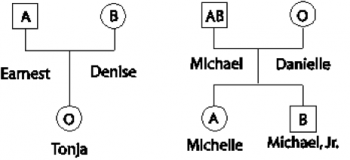
Family tree by blood type

This analysis and discussion activity contains three "soap opera" episodes that help students to understand the principles of inheritance and the relevance of genetics to everyday life. In the first episode, students answer the probing questions of a skeptical father who wants to know how his baby could have albinism when neither he nor his wife have albinism.

The second episode, "Were the babies switched?", covers the concepts of codominance, incomplete dominance, and polygenic inheritance, and reinforces student understanding that the alleles of a gene give the instructions for making different versions of a protein.

In the third episode, students analyze sex-linked inheritance. Each episode can be used separately or with other episodes, depending on your teaching goals.

The Student Handout is available in the first two attached files. The Teacher Notes, available in the last two attached files, provide instructional suggestions and background information and explain how this activity is aligned with the Next Generation Science Standards.


Genetics – Major Concepts, Common Misconceptions, and Learning Activities

Part I summarizes key concepts in genetics. Part II presents common misconceptions. Part III recommends an integrated sequence of learning activities on the biological basis of genetics, plus seven human genetics learning activities. These learning activities develop student understanding of key concepts and counteract common misconceptions. Each of these recommended learning activities supports the Next Generation Science Standards (NGSS).

Syndicate content
