
Serendip is an independent site partnering with faculty at multiple colleges and universities around the world. Happy exploring!

Taking a Different Road: How Does Form Change Content?
In Understanding Comics, Scott McCloud makes a point to distinguish form from content. Comics have been traditionally thought of as superhero picture books for an immature audience. More recently, however, comics have grown up. Much as a child might transition from being called Jimmy to James as an adult, now the comic is the graphic novel and its form is being utilized address more serious themes. But what is the effect? How does this format alter the content or the way in which we interpret the material?
A new space:
One of the outcomes derives from the stereotype of comics themselves. To take a very serious issue of a country and its people in turmoil, as Satrapi does in Persepolis, and place it in a historically child-like format alters the space in which our perceptions and interpretations of the novel are formed. It invites the reader into the more basic level of reasoning that we used as children, an exploration of content from a different but formerly familiar place. In the same way that you might reminisce about your younger days when visiting your old elementary school, maybe we are being asked to reminisce about the way we used to think about the world when we’re placed in this youthful space versus the space in a very adult-like piece of literature.


The Classroom as an Evolving Genre
Genres allow us to communicate with each other and challenge our thoughts. Genres have been emerging and evolving because of sociological and psychological aspects. Classrooms can be considered a genre of their own due to the fact they are in constant evolution but they are a genre within the genre that is schools. The genre of classrooms branches out to the evolution of our thoughts and the evolution of the classroom as a learning space and the technology that enriches our experience. For the longest time, classrooms have been defined as enclosed spaces where students go to learn. It is a collaborative effort between students and professors to make classrooms a safe and confortable environment that inspires students to disagree without launching personal attacks, stereotyping, judging, and encourages and expects everyone to respectfully disagree without disagreeing with you as a whole. Students often bring their own experiences and expectations on what they would like to learn. The classroom is constantly evolving as a genre because vigorous discussions encourage us students to challenge each other’s opinions for the sake of better understanding of the lessons at hand as well as the world outside the classroom.


Through Batman's Mask: A Look At Differing Mediums
Before you read this paper, do me a favor. Sit down, relax, and try not to think too much. This paper asks the question, how do you think, and if you are thinking while you are reading about how to think… you can see how the question can become very complicated. Let’s avoid complication for the time being. I want your initial reaction, raw and instinctual. Then, we can debate and complicate the issue until our brains explode.
Now, look at the three pictures below, and for each, say out loud any words that come to your mind.
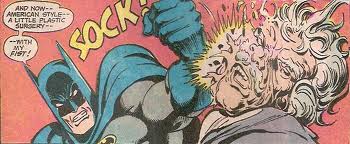

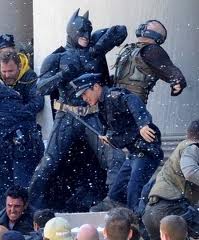


What's That Word For When You Have To Break It To Find It?
“Change. Change. Change. Change…change. Change. Chaaange. When you say words a lot they don’t mean anything. Or maybe they don’t mean anything anyway, and we just think they do.” -Delirium
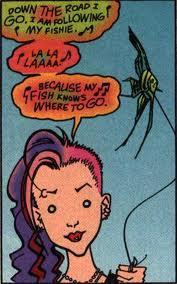
" Fish live next to the bodies of dead pirates."- Kathy Acker
Since our discussion of Persepolis as a story of a young woman attempting to find her own identity among great destruction and trauma, and our subsequent discussions of feminism in relation to graphic narratives, I’ve been stuck on the idea that Neil Gaiman’s Sandman character Delirium might be a nice counterpart to Marjane Satrapi. Delirium, one of seven characters who are the embodiment of earthy concepts, is, like Satrapi, a child trying to find her way in the world. Also like Satrapi, she is the product of some great trauma, though this trauma is never quite defined. However, the resemblance ends there.

Be Like Others: An Issue Transcending Borders
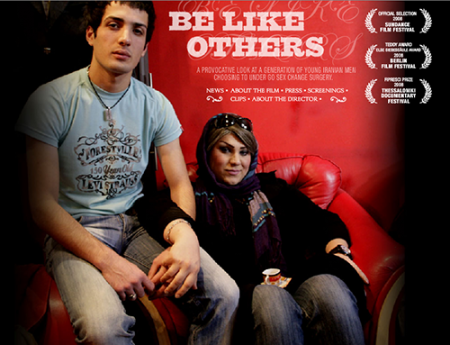
Of the many riveting cultural situations that we have only begun to explore in class so far, one of the most striking were those of men and women born in the body of a sex that they do not identify with and how society responds to them as transgendered individuals. As I approach the question of feminism and how it differs geographically, I want to take a look into the transsexual community in America and compare it to that in Iran, specifically after having watched the film “Be Like Others”.
In the United States, transgender issues are rising to the forefront – in films such as “Boys Don’t Cry” and “Transamerica” and in news stories about transgendered children and the increase in support for these individuals and their families. Coming across the color photography project My Right Self was an experience that provided me with a more personal and moving account of what it is like to be transgendered and hopes to do the same for the public.
The website is an informative project while the photographs are intended to be a traveling show and part of advocacy to benefit the healthcare community, those who are transgendered and their loved ones. The website’s eager invitation to use photography as a vehicle to initiate conversation shows that part of America, even if a slim one; is becoming more accepting and actually attempting to understand this point of view on some level.


A Link Spam (3/1/12) Under Construction! Add yours anyway!
Links for your perusal that may or may not be relevant to class. Add your own! No seriously, add your own.
The H-Word was a series on Bitch Magazine's blog done by a former sex-worker on a variety of issues. I haven't read all of the articles, but I thought the ones I did read were really interesting and worth reading. I would suggest reading most of their series, actually, so go check it out.
Prism Comics is the comic book company mentioned in class.
-There was a very interesting exhibit at Drexel last fall (fall '11) called Half the Sky: Women in the New Art of China full of Chinese women artist's work. I remember reading interviews/articles quoting the artists themselves and how they interacted with/thought of feminism, but I can't remember where I left it at the moment.
Will be edited later. This computer doesn't have my zillions of bookmarks. Also, why don't we have more conversations here? I understand I'm a broken record, but really I just like talking about things with people and this is a convenient (sort of?) way to do it. I know we have more thoughts in class than what we say.

My Gender Workbook: Gender Quiz
Anne brought in Kate Bornstein's My Gender Workbook, and there is an awesome quiz in there that is adapted HERE if you're interested, to see your Gender Aptitude.

Remote Ready Biology Learning Activities

Remote Ready Biology Learning Activities has 50 remote-ready activities, which work for either your classroom or remote teaching.
What's New? Subscribe to Serendip Studio
A Random Walk
New Topics
-
1 week 6 hours ago
-
1 week 6 hours ago
-
1 week 6 hours ago
-
1 week 6 hours ago
-
1 week 3 days ago
