
Serendip is an independent site partnering with faculty at multiple colleges and universities around the world. Happy exploring!

Econ 136: Week 11 Tasks
ECON 136: Week 11 Tasks
Looking ahead to Week 12: We'll have our 2nd midterm on Wednesday, April 16 in class. April 14 will be a review session. It will cover material we've discussed since the beginning of the semester. I'm happy to help you as you prepare. If my office hours don't work for you, then email me with all of the times you might be able to make work and I’m sure we can work something out.
Monday: Endowments and Perpetual Care
Preparing for Class:
Read this brief peek at the dilemmas created by the existence of cemeteries
This Blog post is the briefest (admittedly biased and incomplete) introduction I could find to the controversy surrounding the decision to break the will of the founder of the Barnes Museum.

How to host a difficult conversation?
By 5 p.m. on Sunday, post as a comment here your reflections on one of the central questions raised by our reading of Coetzee's novella, The Lives of Animals: what does it tell us about the possibility that vegetarians and meat-eaters (or anyone w/ decidedly opposed views) can actually enter into productive dialogue? Might some divisions be so deep that common academic training, common culture, or even familial ties can not bridge the gap? (Think of this as a warming-up for your next paper, due next weekend: “how much latitude can we allow”? At what point are we "allowed" to "call the question," and refuse further conversation?)
SO much energy
in our lit classroom, during the past two sessions--it left me breathless today (and I loved it!). Wanting, like Jessica, to use this spillover place that is Serendip, which gives us room for what we don't have "in-class" time for, I want to follow-up on some of the distinctions Simona's been making about 'real facts' and 'subjective stories,'
starting with some short readings: a piece in Geology, 2014 about The science of subjectivity; and three talks, delivered in a faculty discussion group 10 years ago--one by Arlo Weil, another by David, another by me...
and then there's this March 31st NYTimes piece about how College Classes Use Arts to Brace for Climate Change...
To be continued (I hope!)

Such thing as too much energy in a classroom?
We didn't have quite enough time for me to bring this up in class, but I'm really interested to know what you guys think of the following situation...
Most schools if not all tell teach their students to stand and walk in perfect lines, to sit straight in their desks, to put their hands behind their backs, to not speak unless given permission. Authoritive and controlling we apppear to children when shouldn't we be embracing their innocense and let their energy flow not strain?
Teachers complain to parents about their kids having too much energy, but why do schools make it seem like such a bad thing?
Has anyone else thought about this?
crime plummets in camden
To discuss: "full deployment of 160 'eye-in-the-sky' cameras, and other
high-tech equipment that remotely monitors whole swaths of the city...
'It's like Big Brother, but I just don't care.... If they don't get jobs, things will stay the same'"....
http://www.philly.com/philly/news/new_jersey/Crime_plummets_in_Camden_could_a_city_recovery_be_underway.html
allegorical panels
This looks like remarkable work-- http://prisonphotography.org/2014/03/05/prisoners-39-panel-allegorical-mural-made-from-bedsheets-hair-gel-and-stacks-of-newspapers/ --and it was on display @ The Church Studios, in the Fairmount section of Philadelphia.
Re-imagining the iconography of maps
I just came across a very powerful illustration of the central idea of our course: that all representations are limited. This article in today's edition of The Guardian, on Why Google Maps gets Africa wrong, tells the interesting story of the limitations of maps. There are strong eco- and econ-threads in all of this, from the early mapmakers who would "fill their gaps" with "elephants for want of towns," through the Berlin Conference, where "Europe's colonial powers coloured in their territories with their imperial hue-of-choice" (we saw this represented in Shonibare's "Scramble for Africa")--
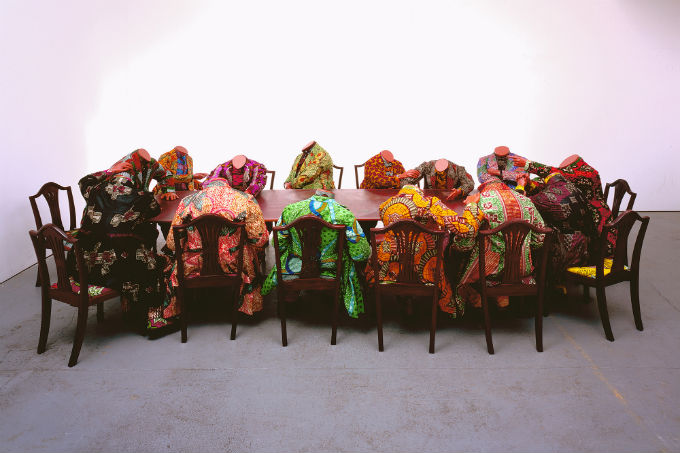
--through today's Google maps, "driven by commercial multinational profitability" and "the prospects of advertising revenue." Google maps are "produced on the west coast of America," which "necessarily affects how they are made." Imagine, instead, that "all of Google's data and programming ability was suddenly in the hands of a Namibian agriculturalist, a Sahelian nomad or a Senegalese fisherwoman – the maps they would conjure up would be completely different. They might well prioritise soil types over Starbucks, wells over Walmarts and the state of land degradation over panoramic street views of American towns."
Imagine.

Anti-Vignette
I don’t feel I can write about my praxis in this forum. Even without naming students or sharing identifying information, the dialogue we have in our focus groups is so personal and vulnerable making that I don’t want to either expose people by reflecting on moments in the groups or make them personally uncomfortable when seeing the way I’ve reflected specifically on a moment in the work (by telling a vignette).
In spite of avoiding or rejecting the idea of writing a vignette on this Praxis, I will reflect on an important moment of connection I had with theory and experience within the Praxis. In our group on Sunday, I used educational theory to help reflect with our participants on the meta-processes happening in the sharing they were doing. After a moment of tension, we reflected together on Ellsworth’s idea that true dialogue is impossible and acknowledged that we were all coming into the room with different assumptions about each other’s identities. We also acknowledged the immense listening and openness required to understand – even partially – the many layers of identity we all came with. At the tea for the Identity Matters 360º yesterday, one of the professors mentioned that she doesn’t see a person as a single identity or whole being, but instead as many layers and intersections. I definitely see this play out in all of the focus groups we’ve held, and I appreciate the way it complexifies our understandings of topics, events, and each other.

Remote Ready Biology Learning Activities

Remote Ready Biology Learning Activities has 50 remote-ready activities, which work for either your classroom or remote teaching.
What's New? Subscribe to Serendip Studio
A Random Walk
New Topics
-
3 days 55 min ago
-
3 days 55 min ago
-
3 days 55 min ago
-
3 days 55 min ago
-
5 days 23 hours ago
