
Serendip is an independent site partnering with faculty at multiple colleges and universities around the world. Happy exploring!

Susan Anderson's picture

Finding a Particular Significance in Cats on the Internet


Welcome II the Terrordome

About the Film
Year Released: 
1995
Running Time: 
90
Documentary/Fiction: 
Fiction
Synopsis: 

Welcome II The Terrordome is a fast paced, vibrant, action thriller set in the decaying and racially segregated city of the near future. Employing a powerful mixture of historical narratives, the film charts the life of the McBride family over three traumatic centuries. Running parallel to the main themes of the simmering sexuality and interracial love are underlying stories of gang violence, police brutality and revenge. The visual style is strong and unflinching, the message biting.

(“Onwurah Filmography" - http://brit-black-pack.tripod.com/id1.html)

Poster Image: 
Director
Film Director: 
Production Info
Reported or Estimated Budget: 
£5,000
Location: 
UK
Other Interesting Production Info: 
Director Ngozi Onwurah struggled for three years to get funding for this film (IMDB). Her brother Simon Onwurah produced it.
Categories About the Film
Genre: 
action
drama
sci-fi
Keywords: 
family
history and memory
interracial relations
state violence and security
urban life
Racial/Ethnic Affiliation: 
African
British
Filmmaking Team
Writer's Name: 
Ngozi Onwurah
Producer: 
Simon Onwurah
Cinematographer: 
Bruno de Keyzer, Dean Semler
Primary Cast: 
Suzette Llewellyn, Saffron Burrows, Brian Bovell, Felix Joseph
Exhibition/Distribution Info
Distributor: 
Delta Entertainment Corporation, MTI Home Video (2001, USA), Metro Tartan Distribution Ltd.
Where to find it/How to get it: 
DVD widely available
Festivals/Awards: 

1995 Verona Love Screens Festival in Italy (Audience Award), Birmingham International Film Festival (1st Prize), Cologne Film Festival (1st Prize)

Analysis
Personal Film Review and Cultural Context: 

In Ngozi Onwurah’s drama Welcome II the Terrordome, the Nigerian-British filmmaker melds past and present, filmic and factual as she explores race relations in the futuristic dystopia of Terrordome.  A drug- and gang-ridden community caged off from the white world, Terrordome is home to Anjela, her brother Spike, and his expecting white girlfriend Jodie.  When Jodie’s white ex-boyfriend discovers that she had “crossed over”, he returns to the Terrordome for revenge.  His revenge results in an all-out race war as Anjela transforms from nurturing mother to militant fighter.  Onwurah’s film captures the plight of the female protagonists as they are faced with the violence incurred not only by the limitations of race, but also the challenge of crossing colored boundaries.  Welcome II the Terrordome recognizes the role of women while demonstrating how the future is compromised when history has not yet been reconciled.  Screened from the Verona Love Screens Film Festival in Italy to the Cologne Film Festival in Germany, this political action thriller is one of the first independent Black British feature.  It captures Onwurah’s experimental and (auto-)ethnographic essence evident in her other works such as Coffee Colored Children (1988) and The Body Beautiful (1991).

(Jacinda Tran, 2012)

Drylongso

About the Film
Year Released: 
1993
Running Time: 
86
Documentary/Fiction: 
Fiction
Synopsis: 

“Drylongso” is an old African American term that means “ordinary,” or “just the same old thing.” Ambitious and densely packed, Cauleen Smith’s remarkable debut feature addresses the everydayness of violence and the extraordinary beauty of daily life.

Pica is a young woman growing up in Oakland, California, who feels deeply the value and vulnerability of everyone’s life but her own. At home her room is perpetually violated by her mother’s partying visitors, and her work in illegal poster distribution puts her in nightly danger of attack. At school she is unable to make any progress on her 35 mm photography project. Instead, armed with charming savvy and a Polaroid camera, Pica tirelessly documents the existence of young black men, whom she believes to be an endangered species.

Along the way, she snaps a photo of Tobi, a young black woman, disguised as a man, who is running from a violent boyfriend. Tobi discovers that her assumed gender gives her new strength and freedom of movement around the city. Fate, however, does not spare Pica’s boyfriend, Malik, and his death inspires her to turn the rampant casual violence into something transcendently beautiful through her art.

Full of irony and inspired by the lyrics and rhythms of hip-hop music, Drylongso breathes fresh air into popular notions of black culture.

If black men are endangered, black women are still safer when they dress as black men. Shot on a shoestring budget, Drylongso is a filmmaking triumph which tells a story that needs to be heard."

(Shari Frilot, 1999 Sundance Film Festival - http://history.sundance.org/films/1984)

Poster Image: 
Director
Film Director: 
Production Info
Reported or Estimated Budget: 
$25,000
Location: 
Oakland, CA
Other Interesting Production Info: 
This is a low-budget, low-tech 16mm feature filmed over 22 days. It is also low-key in terms of the kind of publicity and distribution it has received.
Categories About the Film
Genre: 
coming of age
drama
family
period drama
Keywords: 
activism and social justice
art and culture
coming of age
domestic violence
family
sexual abuse
state violence and security
urban life
Racial/Ethnic Affiliation: 
African American
Filmmaking Team
Writer's Name: 
Salim Akil, Cauleen Smith
Producer: 
Nation Sack Filmworks Production
Cinematographer: 
Andrew Black
Primary Cast: 
Toby Smith, April Barnett, Will Power
Exhibition/Distribution Info
Distributor: 
The Asylum
Where to find it/How to get it: 
Rare and hard to find
Festivals/Awards: 

Grand Jury Prize for “Best Feature Film” at Underworld Film Festival (1999), “Someone to Watch Award” at Independent Spirit Awards (1999); screened at Philadelphia Festival of World Cinema, Sundance*, Hamptons Film Festival*, San Francisco Film Arts Festival, SxSW, The Other America Festival, Classically Independent Film Festival, New Orleans Film and Video Festival, Atlanta Film and Video Festival 

Analysis
Readings: 
  • Obenson, Tambay A. "Cauleen Smith Talks The Power Of Cinema, Afrofuturism Watch Some Of Her Recent Short Pieces," from Shadow & Act. Indiewire, 29 Jun 2011. Web. 1 Dec. 2012. <http://blogs.indiewire.com/shadowandact/cauleen_smith_talks_the_power_of_cinema_afrofuturism_watch_some_of_her_rece>.
  • Urbani, Diane D. "Oaklander's Film Well Received at Sundance," from Oakland Post: 8. Ethnic NewsWatch. Feb 10 1999. Web. 1 Dec. 2012. <http://search.proquest.com/docview/367197126/13ABE0D06463201D711/20?accountid=9772>
  • Varner, Sandra. "'Drylongso' - Cauleen Smith's Bittersweet Tale," from Oakland Post: 8. Ethnic NewsWatch. Aug 11 1999. Web. 1 Dec. 2012 .<http://search.proquest.com/docview/367357901?accountid=9772>.
Elizabeth's picture

The Gilted Fish Bowl

I thought going back to my site sit would be scary. I've walked past the  tree a few times, and it's lost most of its leaves. Its silver branches and a some auburn, dead leaves (mostly on one side of the tree) are all that remain of the lush, green tent I used to sit in. I went to my site sit when it was dark, too, so I thought that I wouldn't feel very comfortable in the tree anymore. But, the only really unsettling thing about my site sit was that all of the leaves were gone. People could see inside and I could see them with remarkable clarity. The tree has changed it's physicality for the season, and its atmosphere has, too. The frightening mystery I first felt at the beginning of the semester would have been gone even if the tree had kept its green leaves. The tree and I are pretty "chill" now. I wouldn't say that we're going to be best friends any time soon, but I've gotten used to it, at least a few branches of it. I don't know what I'll do in the tree when the semester is over, but I think I'll visit from time to time to say hello.

wanhong's picture

The Beauty of Subjectivity--For All Nature Writers
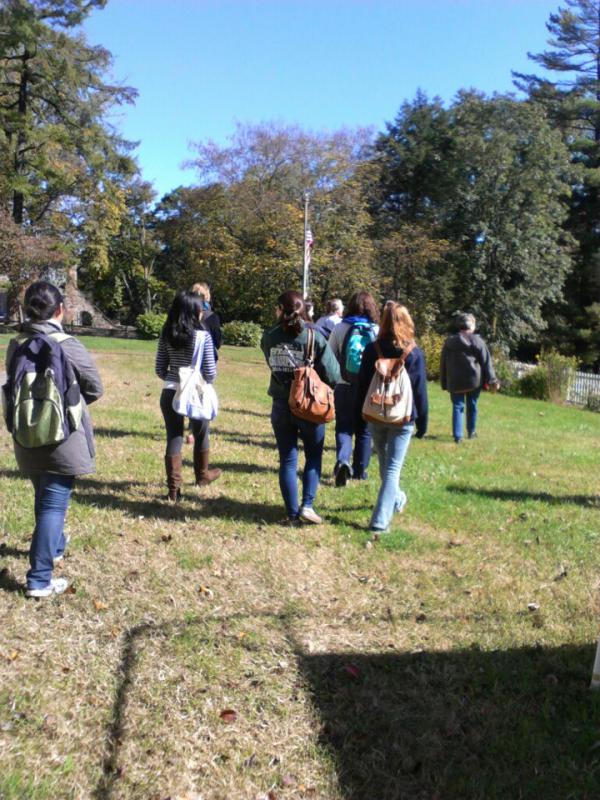
HarritonTogether


My Ecological Imaginings Class at Bryn College led me to an amazing adventure, rather than journey, to explore the concepts of nature and write about it. The most important thing that I have noticed, after writing essays and participating in class discussions, is that there should be no scale for writing nature when we are thinking ecologically. It is important for every nature writer to know that there is always an essential and unavoidable diversity in writings due to various personal background and beliefs, and what we should try to do is, rather than objecting other peoples’ opinions severely, developing new ideas based on them.

The author of almost every reading material for our class was trying to tell us how we “should” perceive the relationship between human and nature or what the standard of “good, natural” writing is, and it had taken me a long time before I realized that I could academically benefit from their seemingly judgmental ideas. In his introduction to The Dream of the Earth, Thomas Berry wrote that “we must now understand that our own well-being can be achieved only through the well-being of the entire natural world about us” (<?xml:namespace prefix = st1 />Berry, Introduction XV). In Women Writing Nature—A Feminist View, Barbara J.

Sara Lazarovska's picture

Throwing Away Typical Environmentalist Assumptions

            If you are a young urban denizen pursuing higher education that lives in the city and is up-to-date with the environmental news of this century, you have been fed information by a number of ecological writers, given “environmentally conscious” advice to get yourself out of your home and “experience nature.”

Bran Nue Dae (Brand New Day)

About the Film
Year Released: 
2009
Running Time: 
88
Documentary/Fiction: 
Fiction
Synopsis: 

In her second time at the Sundance Film Festival, Rachel Perkins brings to the screen an adaptation of Jimmy Chi’s popular stage musical Bran Nue Dae, which was a national hit in Australia. It’s the summer of 1969, and with his evangelical mother pointing him toward the priesthood, earnest young Willie (Rocky McKenzie) attends a Catholic boarding school in Perth but, protesting its strict rules, runs away to his homeland. With Father Benedictus (Geoffrey Rush) in hot pursuit, he heads back to Broome, acquiring traveling companions along the way.

With songs and dances rooted in traditional Aboriginal performance, blues, rock and roll, Hollywood musicals, and the rituals of the Roman Catholic Mass, Willie sings and dances his way back to his own land and inspires the people around him to find their own truth. The colors of Aboriginal Australia shimmer in this wonderfully exuberant film, giving viewers a joyful romp while simultaneously touching on Aboriginal history and politics in a way that leaves us all wanting to be Aborigines.

— N. Bird Runningwater, Sundance Institute
Director
Film Director: 
Production Info
Reported or Estimated Budget: 
$6815253 (converted from AUD)
Location: 
(Broome, Fremantle, Kununurra, Perth), Western Australia
Categories About the Film
Genre: 
adventure
comedy
dance
family
musical
romance
Keywords: 
education
family
history and memory
interracial relations
rural life
Racial/Ethnic Affiliation: 
Australian
Filmmaking Team
Writer's Name: 
Reg Cribb, Rachel Perkins, Jimmy Chi
Producer: 
Graeme Isaac, Robyn Kershaw
Cinematographer: 
Andrew Lesnie
Primary Cast: 
Rocky McKenzie, Jessica Mauboy, Ernie Dingo, Missy Higgins, Geoffrey Rush, Tom Budge, Ningali Lawford, Deborah Mailman
Exhibition/Distribution Info
Distributor: 
Freestyle Releasing
Box Office Earnings: 
$110029
Where to find it/How to get it: 
DVD widely available
Festivals/Awards: 

Debuted at Melbourne International Film Festival, debuted internationally at Toronto International Film Festival, went to Sundance Film Festval.

  • Awards:  Australian Film Institute Award for best supporting actress for Deborah Mailman
  • Film Critics Circle of Australia Award for best music score for Cezary Skubiszewski
  • Melbourne International Film Festival award for most popular feature film
Analysis
Personal Film Review and Cultural Context: 

Loosely based on the acclaimed Australian stage musical, Bran Nue Dae follows Willie as he faces shame at his Catholic boarding school because he is an aborigine and then starts a personal rebellion to make his way home to his love, Rosie. Daughter of notable Aborigine activist, Charles Perkins, award-winning director Rachel Perkins has worked tirelessly to promote indigenous filmmakers and here has created a hilarious and accessible film that keeps your toes tapping and your spirits up. Bran Nue Dae is one of very few films in the public eye that represent people of aboriginal descent in a more lively way that avoids stereotypes and still has fun along the way. Offset by the dry, dusty plains of Western Australia, the choreography is bright and playful, mixing traditional and modern moves. Making his way across this landscape, Willie picks up eccentric and unusual friends. With a surprise ending, the film plays with family configurations and shows us how journeys to find ourselves can often result in finding new parts we never knew we had. Written by Delia Bloom

Shengjia-Ashley's picture

Chaos left unanswered

It is very difficult for me to write the last site sit. The rain is seeking into my hair; my head is aching with reflections of how this semester had been for me. I couldn’t help to take retrospective examination of myself and my site. The exuberance beech trees I see from “Carpenter beach” have only a few leaves left now. People loved to lie on the beach at the beginning of the semester haven’t returned for a long time. The grass stayed relatively the same: well-trimmed. My mind is not well-trimmed but muddy and clustering like the fallen leaves in the corners and sides of the trials.

The voices of the ecologists were arguing in my head. Are human doomed by human’s encroaching the earth? Or is the environmental crisis just an imagination of some ecologists? How should we represent the world? Can we compose an understandable literature without human as a subject? Or is human an inseparable part of the ecology? What shaped the actions of human in the nature environment? Is it the fear of nature or the control of the landscape? How should we speak green? Radically or simply let it be and enjoy what we have now…

 Many questions are still left unanswered. Many topics are still open in the untamed space of imaginations. Even though the class is coming to an end, I don’t think I can simply left the chaos of the different world views, opinions and imagination in the readings we have done. There is much I can ponder on for years.

CMJ's picture

#PROVOCATIVETITLE

            People of the world! We have problems, and these problems are as big as the earth itself. People of the world, we must solve these problems or perish. This is the discourse of every environmental theorist, writer, or scientist. We have come to a cross roads in our existence here on earth, one where we choose to live and save other species in the process, or one where we exterminate those around us, then die ourselves. Certainly bleak prospects. Either way, we shall be required to give something up, to change fundamentally, to stage a revolution, and accept that we are part of a larger ecological system.

Rochelle W.'s picture

Abandoning Despair


Abandoning Despair

Picture this: A city where some houses stand in water that has risen to the windows of their second floor. Other houses do not stand at all but now only consist of a basement filled with the former first floor and a roof to cover it up. Cars are flipped onto their sides and crushed like cardboard boxes. There are fallen trees, scattered planks of wood, broken glass, and upturned furniture lining some streets, and slow moving rivers where other street used to be. There are no people. Everyone has left.


Syndicate content
