
Serendip is an independent site partnering with faculty at multiple colleges and universities around the world. Happy exploring!

My Diffraction.
I began the course excited to see how far I would be able to push the boundaries of my knowledge about gender and sexuality studies but I was a little bit concerned that the class was to meet only once a week and at night. Seeing as I had never participated in a course that was like this, I was a bit nervous that I would not be able to keep track of everything that was going on in the class and that the conversations would not flow as well as I was accustomed to.
At the end of the course, I still feel the same way about many of my assumptions about the course. Given its entangled nature, I felt that I definitely valorised the two and a half hours we spent as a group once a week. I found it difficult to keep my thoughts flowing because of the large gaps between classes and as a result, I found that this was the biggest factor in keeping me from learning as much as I could. Although I am a fan of Serendip and appreciate how conversations can go on outside of the classroom in the ‘virtual’ world, I found that it just was not the same as meeting each other face to face. Though this was the case, I did find myself talking to others in the group about the subject material and this was a nice way to keep myself participating. This drawback was definitely a personal thing however, I have heard of others that liked the once a week meetings and online discussions.

Final(ish) thoughts!
Everything that went on in class today made we realize how much I've come to love ESem. I'll admit it, In the beginning, I was quiet, unsure, and cursing myself for choosing a topic which I knew nothing about. After these 13 weeks I'm glad to say that I definitely feel differently. So, like we did with Parkway, I have some thank yous for you all as well:
Thank you for introducing new points of view to me, and being willing to share your unique backgrounds.
Thanks for always being such an open, understanding group.
Thanks for being the only one of my classes that I actually feel close to, and that I know everyone's name.
Thanks for being so awesome outside of class, too.
And finally (and repetitively), thanks for being my friends. It really means a lot.
I hope that we can continue to remain close. Thanks for a great semester!
Hayley

Want to share books with me?
Want to share books with me?
My name is Michaela, and I’m an upper-middle class white girl. (Hi, Michaela).
Well then. Now that we’re all a little more acquainted (or at least you know something a little personal about me), let’s talk.
I’ve been at Bryn Mawr as a student now for approximately 3 ½ months, but I spent many of my formative (read: awkward teenage) years here as the kid sister to a BMC student. My sister graduated class of 2010—another fact about me, another thing that I don’t necessarily like to bring up for fear that it reveals my unfair privilege.
In high school, I tried to empathize with the less well-off kids at my fairly diverse, but still very wealthy, public school. I’m from around DC, so I wanted to identify with the “real people” of DC, not the ones like me who were truly from the affluent Maryland suburbs but told people that they were from the city (the count is up to three on things that I’ve now told you about myself that are a little tough/embarrassing/shameful (?) to share. If you comment, will you tell me at least one?)

Environmental Justice tied to Economic Justice
On Tuesday, I decided to participate in a direct, non-violent action against PNC bank in Philadelphia instead of going to class. The group I participated with is called the Earth Quaker Action Team (EQAT) and although they are primarily an environmental justice group, the action was actually focused on jobs and economic justice as well as environmental justice. PNC invests in mountain top removal coal mining in Appalachia, where basically mountaintops are blasted off to get the coal in the ground for energy uses. EQAT has lead a campaign to get PNC to divest from this for the past three years now. However, during the two groups’ last interaction, PNC defended their investment by stating that it creates jobs for the people in Appalachia, an area that happens to be a very poor part of the country in general. While this does provide jobs, it’s jobs that are harmful to the employees and are not sustainable. Also, the practice itself adversely affects the people who live in Appalachia in many ways – cancer rates have increased, more babies are born with birth defects, and many people don’t have access to clean water in their homes.

Questioning Gender Through Dance
First of all, apologies for being antisocial and doing my teach-in so individually. I really liked the group participation that so many of the other ones provided and I'm sorry mine kind of lacked that dimension!
For my presentation, I wanted to showcase some of the instances in which the assumptions about gender that we've been questioning all semester get questioned variously embodied ways in four distinct dance worlds, suggesting that in its inherent playfulness and performativity, dance is an important outlet for the creative expression of gender, both normative and nonnormative.
(Before I go through them, here's a great TED talk, Dance vs powerpoint, that inspired me to think about how one might do a "teach-in" that incorporates dance. If I had more than 7 minutes, I would have been doing some movement myself -- and getting you all to move, too!)

You have reached your destination, please open and see what's inside
Masquerade Ball: A Message to the Pretenders
pretending [pri-tend-ing] (v.) – the act of being something you are not
upper class [up∙per-class] (n.) – a class of people above the middle class, having the highest social rank or standing based on wealth, family connections, and the like
middle class [mid∙dle-class] (n.) – a class of people intermediate between the classes of higher and lower social rank or standing; the social, economic, cultural class, having approximately average status, income, education, tastes, and the like.
lower class [low∙er-class] (n.) – a class of people below the middle class, having the lowest social rank or standing due to low income, lack of skills or education, and the like.
mask [mask] (v.) – to disguise or conceal; hide; dissemble
Why is it that we pretend to be something we are not? “Poor people want to be rich. Rich people want to, well, blend in”
TOP TEN WAYS TO HIDE BEING RICH

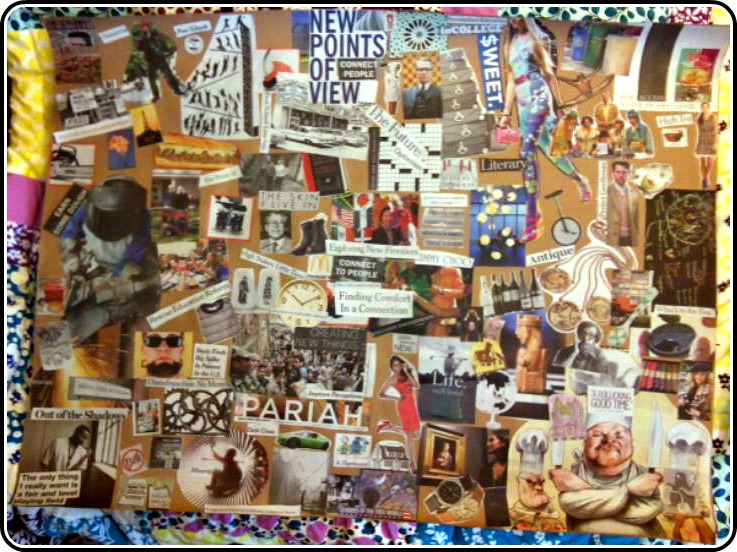
New Points of View
Hello All,
This collage is titled “New Points of View,” and it aims to represent the various experiences and cultural capital we bring with us here to Bryn Mawr. Ultimately, social class is another form of diversity such as gender, race, or ethnicity. It shapes who we are and how we experience the world around us. However, social class is different from all of these things in the fact that the topic is alarmingly taboo. Although, like race and gender, it is something we are usually born into, we feel uncomfortable embracing it or even acknowledging its existance. This collage aims to ask the viewer whose culture has capital. Do we all have cultural capital? Whose is most important? Is anyone's cultural capital more valuable than others? Is there a way that we can acknowledge these differences rather than ignore them? And finally, how do we “bridge the gap” and learn from one another?
What differences do you see between the left side and the right side? Are these differences important? Which one more closely mirrors your experience?
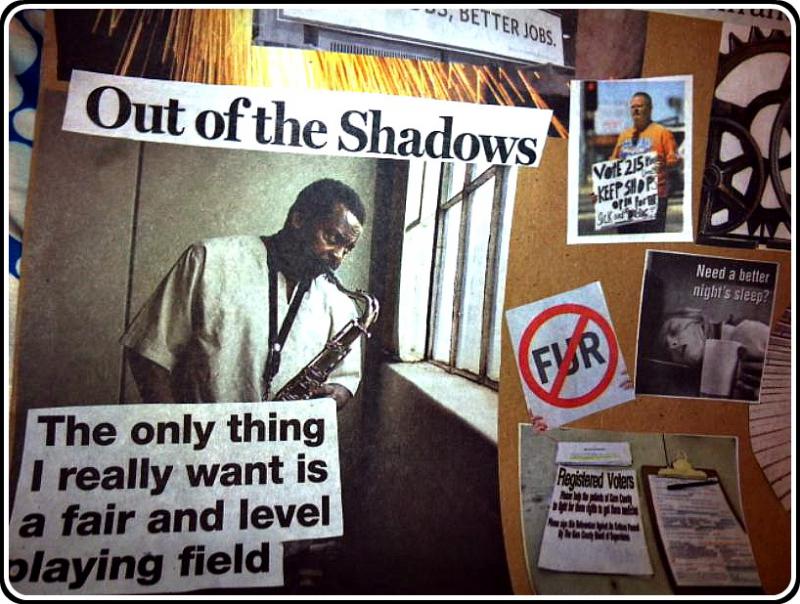
What are your feelings about the American Dream? Is it attainable for everyone?


Hillary Clinton's speech
Hi everyone,
I just wanted to say that I'm heartened that this space will live on past the official ending of our class/ semester. In the spirit of perpetual online communities I thought I would make one more post regarding activism and current events.
Has anyone seen this?? It speaks to the concept of rights in regards to cultural relativism. We've been talking a lot about the importance of individual activism on a structural level. It's rather hard to conceptualize how an individual such as myself could possibly go about creating change on anything but an individual level. I'm not a member of congress. I'm not a millionaire. I'm certainly not Paul Farmer.
Believe me, I appreciate the value of social movements and the inherent potential of many voices mobilized against oppressive power structures. But we also have to think about our elected leaders as resources for change. While social movements are vital to cultural structural change, government leaders have the capacity for structural and legal change. The symbolic power of government public protection and recognition can go a long way for both activists and opponents.

Remote Ready Biology Learning Activities

Remote Ready Biology Learning Activities has 50 remote-ready activities, which work for either your classroom or remote teaching.
What's New? Subscribe to Serendip Studio
A Random Walk
New Topics
-
1 week 17 hours ago
-
1 week 17 hours ago
-
1 week 17 hours ago
-
1 week 17 hours ago
-
1 week 3 days ago
