
Serendip is an independent site partnering with faculty at multiple colleges and universities around the world. Happy exploring!

Dialogue Reflections: Class, Learning, Culture
I’m coming away from reading Friere’s and Shor’s A Pedagogy for Liberation with three central themes I’d like to discuss further:
1) I thought the acknowledgement that “The right to have a small discussion begins as a class privilege” (p. 98) was really interesting, and sadly often true. The authors discussed this reality in terms of resources, ability to have small class sizes, etc. but I think this pedagogical reality is also a function of the false (or what I view to be false) notion that students have to “learn the basics first,” before they can converse and have rich, meaningful dialogues. I’d like to further discuss how this emphasis on promoting dialogue in the classroom can be used draw students in and engage them while also learning content and skills, as opposed to only coming as a privilege, after the fact.
2) I appreciated the concept that dialogue prompts the teacher to also engage in continuous learning: “Dialogue is the sealing together of the teacher and the student in the joint act of knowing and re-knowing the object of study” (p. 100). I agree that through dialogue, the teacher can learn just as much from as they teach to students—if done well. But I do wonder, is this a guarantee? Can a teacher successfully promote dialogue without being open to learning themselves? What are the implications of this?

The Civic Empowerment Gap, Universal Values, and Working in or out of a System
At a general, my-personal-values level, I think that I believe in Levinson’s point that the “civic empowerment gap” is a big issue. In a country where we put democracy on a pedestal and where the structures, policies, etc. of our country are decided by a so-called democratic process, it really doesn’t work if huge groups of people simply aren’t being heard.
In light of the Boler chapter on teaching socio-emotional skills and subsequent class discussion about the problems with teaching “universal” values and skills, however, I found this chapter more troubling and confusing. I think that there is a lot of potential for undermining the lived experiences of students, for undermining the action that they do take in their lives, and teaching them to incorporate themselves and work within a structure that is actually really detrimental to them (and is, in fact, a reason why they are less civically engaged).

the privilege of a small college
In the conversation between Ira Shor and Paulo Friere, Ira brings up the point that in most college classes, teachers "didactically lecture" to students, a "'cost effective' education" with "minimum personal contact between professors and students". She goes on to day that professor-contact and dialogue is reserved "for students at the most costly universities, where money is invested in small classes for the elite." When reading this, I immediately thought of the small classes at Haverford and Bryn Mawr. I always thought of this as a perk of going to a smaller college, but after reading this, I realized that it is a privilege that few students get to experience.
Many of my friends from high school went to UMass Amherst, the flagship MA state school. Though they are still recieving a quality education, I was shocked when they told me about their lectures, which could be as big as 400 people. They can't really ask questions, have no class discussion, and their professor doesn't know their name. They were equally surprised when I told them about my 15-30 person classes, where the professor knows each person individually, classes are discussion-based, and there are no TA's. UMass is a much more affordable option for some people than an elite private school. I am lucky to be able to afford to go to a small liberal arts school, and I have taken the advantages of small classes for granted.

Cognitive Engagement determines success or failure
Although I am physically unable to attend class, I wanted to share my opinions on the reading and the thoughts it sparked.
"Language choices and practices determine who has access to resources, power, and control and who does not. Foreing language alienates children." Again, we talk in terms of accessibility and how important of a role in plays into individual's choices to be aware of their environment before they can even become a part of it. This reading brings up an important issue, how do we wish to spread environmental awareness and knowledge if we can't expand our ways of doing so? A lot of the times people underestimate the abilties and knowledge capabilties of minorities because they don't believe WE are able to obtain the importance of issues like environmental studies. WILD, a program dedicated to reaching out to those who aren't as accessible to educational resources, is a program that all other organizations and programs should learn from.
Heartbeat
Heartbeat, a novel written by Sharon Creech is a book unlike any other that I read growing up. I was never really the kind of child to read books outside of class and my parents never really encouraged the importance of books. It wasn’t until middle school, at age twelve that I came across Heartbeat and since then I’ve been in love with Sharon Creech’s work.
Heartbeat is a novel written in verse. It’s a short poetic novel narrated by twelve-year-old Annie about the changes happening around her environment and how she finds running to be an outlet to handle it all. The free verse written style in the novel is a reflection of Annie’s mood and how everything in her mind flows when she’s running and thinking.
Annie is a twelve-year-old girl trying to understand herself and her emotions, but at the same time the many different things changing around her life. In the beginning of the novel, she has no stability and is overwhelmed by the things in life she can’t seem to understand or control, like that of her grandfather developing dementia and growing old while her mother is expecting a new born child which seems completely bizarre to Annie because she’s an only child. Then there’s also the relationship with her best friend, Max who makes Annie question why she runs and explores the role that running plays into Annie’s life.

Monkeys Smoking Pipes and Other Occasions of Disorderly Conduct
Curious George is a series of children’s picture books written by H. A. Rey. I will be writing about the first book of the series, titled, Curious George. The events of the book can be summarized as such: A curious monkey is kidnapped from Africa by a man with a yellow hat and is taken to a big city. Being curious and wanting to imitate the man using the telephone, George unintentionally telephones the fire station, prompting the firefighters’ swift arrival to find no fire, but only a troublesome monkey. They take him to prison, from which George manages to escape, take flight with a bunch of balloons, serendipitously land next to the man with the yellow hat, who then accordingly delivers George to his new home that is the city zoo.

Miss Rumphius: The Lupine Lady
The book I chose to analyze is called Miss Rumphius written by Barbara Cooney. A summary of the story is about a little girl named Alice and her grandfather would tell her stories about living in faraway places. She tells him that when she grows older she would like to travel to faraway places and live by the sea. But her grandfather tells her that she must also make the world more beautiful. The story continues when she is all grown up and begins traveling to faraway places such as tropical islands, mountains, jungles, and deserts. Then after her travels she finds a little house by the sea to live in and she plants flowers in her garden. After she plants the flowers she becomes ill and stays in her home for most of spring. When she was well enough the next time spring came in she had lupines in her garden. She realizes that in order to make the world more beautiful she will plant lupine seeds everywhere so that they will bloom the following spring. When spring came around there were lupines everywhere and everyone called her The Lupine Lady. At the end of the book she tells her niece that she must also do something to make the world more beautiful.

The Story of May
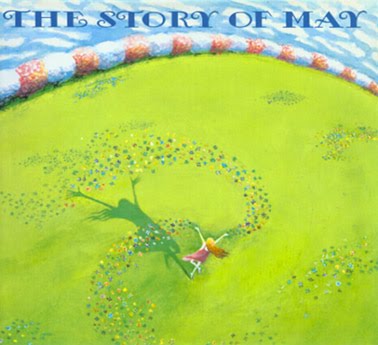 The Story of May by Mordicai Gerstein was always a favorite of mine as a kid. This short and sweet picture book tells the story of a little girl, the month of May, and her journey through the year to meet her father December. She leaves her mother April’s side and meets all of her relatives in an “exuberant story of familial love set in the richness of the passing seasons” (HarperCollins Publishers, inside cover). I choose this book because of the wonderment of earth, nature, and the seasons it helped instill in me as a young girl. I so easily connected with May, and I believe her journey of play and independence helped me ‘access’ a new version of the world, one in which nature and the environment are paramount, and everything flows together calmly with time. The stunning watercolor illustrations came to life in my head; when I see them now, I’m surprised that the pictures end where the page does, and don’t all carry on endlessly.

The Giver: Children and Environment
The Giver, a children’s novel by Lois Lowry, was first published in 1993. It tells the story of Jonas, who lives in a society that has converted to Sameness—everything is strictly controlled, there are no animals or colors, there is no war or fear or pain or choices. When Jonas turns twelve, he is selected to the next Receiver of Memory, the one person in the community whose job it is to store all of the memories from before Sameness—memories of both joy and pain— and occasionally provide the Elders with advice based on those memories. As the Giver, as the old Receiver of Memory tells Jonas to call him, transfers the memories to Jonas, Jonas comes to question whether Sameness is really as good as he’s been brought up to believe. Eventually, when Jonas learns that Gabe, a baby his family has been caring for, is going to be released—which he discovers during his training is a euphemism for lethal injection—he runs away with Gabe, and the memories that he received from the Giver are released back into the community. The book ends when Jonas and Gabe, near death from cold and starvation, find a sled and ride it down a snowy hill, toward a house filled with colors and love and music. “Behind him, across vast distances of space and time, from the place he had left, he thought he heard music too. But perhaps it was only an echo.”

May the Odds Be Ever in Your Favor
The Hunger Games is a 2008 science fiction novel written by Suzanne Collins. Set in the future, this story is narrated by 16-year-old Katniss Everdeen. Katniss, her mother, and her sister, Primrose reside in the poor twelfth district of the nation Panem. Panem consists of twelve districts and the Capitol, which exercises political control over all the districts. In order to maintain its political legitimacy and to punish the twelve districts for a past rebellion, the Capitol hosts the “Hunger Games” each year. At “the Reaping” one boy and one girl between the ages of 12 and 18 from each district are selected by lottery to participate in this event. In the Hunger Games, the contestants or “tributes” must fight to the death until one remains in an outdoor arena controlled by “Gamemakers” at the Capitol. This event is highly televised so people from all the districts and the Capitol are able to watch everything that goes on in the arena.
In the 74th annual Hunger Games, Primrose Everdeen is selected to be tribute in the Hunger Games, but Katniss immediately steps up to take the place of her sister. The male tribute from District 12 is Peeta Mallark, a former classmate of Katniss. A past Hunger Games victor from District 12, Haymitch Abernathy, mentors Peeta and Katniss as they prepare for the event. Throughout the Hunger Games, Katniss utilizes her hunting and survival skills and forms an alliance with Rue, a 12 year old from District 11, as well as with Peeta, her fellow District 12 tribute.

Remote Ready Biology Learning Activities

Remote Ready Biology Learning Activities has 50 remote-ready activities, which work for either your classroom or remote teaching.
What's New? Subscribe to Serendip Studio
A Random Walk
New Topics
-
3 days 15 hours ago
-
3 days 15 hours ago
-
3 days 15 hours ago
-
3 days 15 hours ago
-
6 days 14 hours ago
