
Serendip is an independent site partnering with faculty at multiple colleges and universities around the world. Happy exploring!

Classroom Management
Sleeter's piece on Unstandardizing Cirriculum included some really engaging ways to incorporate students' personal experiences into the classroom as materials for cirriculum. The passage about how the teacher organized a classroom courtroom kind of relates to a challenge I'd noticed at my own Praxis: behavioral management. Angela wanted to incorporate group work and hands-on learning into her curriculum, but many times it would result in losing control of the classroom and taking away time from the lesson. Even if a teacher has a really interactive and well-planned lesson, if she cannot keep the students' attention focused, then she won't be able to facilitate the lesson in the way she wants to. Angela's courtroom simulation brought structure to the classroom by assigning each student with a specific role, and an interesting activity.
There are several students at my placement who, when upset, refuse to participate in activities and keep to themselves in silence or they might find very loud ways to direct the other students' attention towards them. It is not okay to just let the students who consistently act out keep on sitting out from activities. But it's also not okay for the teacher to spend too much time trying to get these students to participate, when the majority of the classroom is paying attention. In many cases, she just continues the lesson while avoiding the students who are trying to bring attention to themselves. I wonder what other ways incorporation of the students' experiences might make classroom management easier.

Harriton House
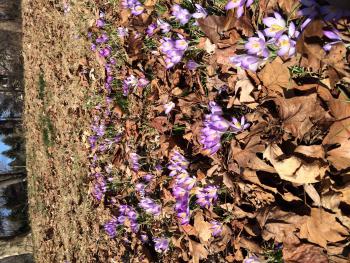
I had an amazing time on our trip to Harriton House on Friday. It started out really frustrating, not having the vans to go to Wissahickon, and knowing that we were going to miss out on a beautiful weather day. As it turned out though, I truly believe that our Plan B was exactly what needed to happen. I was recalling so much of what happened a few weeks ago when our trip to Audubon transformed into a bittersweet series of events. We had fought against the weather with a determination that as humans, we have the ability to 'outsmart' Nature and go on as best as possible, limiting our losses caused by the snow. We all agreed afterward that perhaps we should have 'read the weather' and instead should have given in to our limitations set by the environment. I think whomever made the scheduling conflict with the vans (or whatever ended up being the problem) was reading the weather for us on Friday. The sun and warmth, the crispness in the air, was begging us not to spend so much as a second in a van driving through traffic, navigating our way through Philly. We were meant not to vacate our current location, traveling to find a truly 'natural environment'. (Don't get me wrong, I look forward so much to going to Wissahickon this Friday!) We were, however, meant to read the weather and maximize our time spend outside, walking together, greeting animals, welcoming spring, soaking in the beautiful day. It was amazing to stand in a field of freshly opening crocuses and realize that the ground is literally buzzing with life.

Response to Sleeter's Students as Curriculum
When reading Students as Curriculum, I thought, "ahhh, the problem with urban public schools." I went to urban public schools my whole life, and many aspects that Sleeter mentions is absent in them. For example, in the very beginning of the reading, Sleeter states, "There's a rich resource right in your own classroom... what are their perspectives about being taught, so as often as possible, you know having discussions, hearing their input.” I think that many teachers, who teach in urban public schools, from personal experience and observing in my placement, do not communicate enough with their students. They have these preconceived notions of urban students, and approach them with the banking model. Teachers “treat students as empty vessels into which knowledge is poured for retrieval,” but this is not teaching. Too often, students are not being taught to think critically. Instead, they are given information to remember. In my placement, I do not see much critical thinking. When the students were learning about animals in the aquarium, the teacher would just tell them, “This is a fish and they live in water.” Although the students are in pre-k, I thought they should have been pushed a little more. The teacher could have asked, “How do you think they breathe? We humans breathe, so don’t fish need to breathe too?” Although the students may not have been able to answer the question, it would have gotten them to begin to think of critical questions, instead of simply transferring information.

Sleeter and the zone of proximal learning
I was very interested in the Christine E. Sleeter reading and her conversation her emphasis on framing a students learning around their lives, connecting the classroom to their home and using this knowledge to reinforce their learning. She goes though several examples of how teachers can do this, and provides a structure for understanding the backgrounds of the students. I think this can be a powerful tool with students for a variety of reasons, mostly because this makes a student comfortable in their own classroom, using terminology and situations that they are comfortable with as a framework for learning hard classroom materials. Having access to even the language of the classroom is a huge step and learning and as someone who spend most of her time in classrooms where precise and incapable language is normal; I know that by not understanding one word-not a concept — but a word, can hinder learning until that student has caught up. While I was reading this article, I kept thinking... what about the tests? I believe that this method of learning is very effective, but I kept thinking about what happens when these students are put into a situation that isn't catered to their background and outside lives. But then I thought, but by that point that are comfortable with the topics, they understand them as they have taught them so personally.

Harriton House
I had no idea that Harriton House existed, so I am glad that we were able to walk over and visit. It felt like the perfect spring day. The sun was shining and the flowers were starting to bloom. We all walked about the area a bit and then a majority of the group sat on the grass and took everything in. While I was lying there I was taking in all of the sounds around me. From the sounds of the hammering and construction work to the sounds the sheep made as they were grazing. Harriton House seem like a good get away place where you can just relax and take in the scenery. All of the stress from the week seemed to lift away.

Sheep are part of the complex.
A lot was going through my head on Friday as we went on our walk. Transitions between seasons have always made me emotional. I get utterly homesick and nostalgic, not towards any one home or time in particular; I get homesick and nostalgic for all the places and times in which I've been homesick and nostalgic during seasonal transitions. Change means something is ending, and the next thing is coming, and I dislike endings. Seasons, though - they seem to be telling me that I haven't changed at all and that everything's still okay because I'm still reacting emotionally to the seasons.
And Friday, I felt Spring.
I also felt Nairobi. This naturally luscious and socially wealthy setting with huge, old trees, rich hedges, and walking on asphalt roads with no sidewalks - this was like Muthaiga, an old and wealthy neighbourhood in Nairobi, where I lived for about two years. Of course it wasn’t identical, but I sensed a similar climate.
When we got to Harriton House, I walked around, looked at the house, at the sheep, the horse, the chickens, and then spent a while watching two adolescent-sized cows. Of course, I know nothing about the maturing process of cows, so I don’t know in which stage of life they were, but they seemed like they still had room to grow. I watched them and thought.
Then I sat on the grass with my little notebook and scribbled thoughts. I lay down and scribbled some more. I wrote some flashy phrases and images, but nothing was hitting me in the throat.
Response= "innovative voices in education"
I really enjoyed Karyn Keenan's piece on "The Importance of Student Stories." This piece resonated with me because at my placement, the teacher is supposed to have a morning meeting every day. Though she does not always find the time to do it, when she does, I think it is very beneficial. This seems very similar to when Keenan says that "Carving out the 15 minutes for the Morning Meeting can be a challenge with all the demands facing teachers and their schedules. However, this time to share is crucial for students" (64).
The students at my placement love to share their stories, and the teacher carefully listens to each one, no matter how long-winded or irrelevant it might be. I think that it is very important for these student's voices to be heard, especially since as low-income, minority students, their voice is often muted in several contexts. However one thing that concerns me is that though the teacher listens to each student's story, the students don't listen to each other. They often talk over one another or talk to each other when another student is talking. I think that is is important that the students show respect for each other and learn from each other's experiences, but this is not happening in the classroom. I don't know what can be done about this, but I think peer respect is a crucial element for students to openly share their stories.

Understanding students
One aspect of the readings that I latched onto was the idea that we need to know our students to create a curriculum that blends their interests, experiences, and backgrounds in order to engage with them in learning. Understanding our view points is critical to creating a course that is successful in not just explaining a particular topic, but also in supporting active and aware individuals.
In “Un-standardized Curriculum”, Sleeter states, “…rather than starting curriculum with the textbook or the standards; she [Kathy] stared by identifying a rich theme that was significant to the lives of the children and their families in which subject matter content could be anchored.” (116). I can’t help but play the cynic, but I wonder how most teachers can do that.
There is the issue of not knowing your students from the beginning of the year as I, to my knowledge, know most schools change teachers every year or two years. Building a curriculum or even a lesson plan should revolve around the students’ background, but logistically, that’s hard to know right off the bat. And even later in the year, the teacher would have to make a very decided effort in knowing the students to find ways of catering to them in teaching. As I don’t really know the logistics of some types of schools, I’m not sure how much flexibility the teacher has day by day as far as lesson plans.


Remote Ready Biology Learning Activities

Remote Ready Biology Learning Activities has 50 remote-ready activities, which work for either your classroom or remote teaching.
What's New? Subscribe to Serendip Studio
A Random Walk
New Topics
-
3 days 6 hours ago
-
3 days 6 hours ago
-
3 days 6 hours ago
-
3 days 6 hours ago
-
6 days 5 hours ago
