
Serendip is an independent site partnering with faculty at multiple colleges and universities around the world. Happy exploring!

Paper Two
Jayah Feliciano
February 18, 2013
Paper 2
Theoretical Analysis Reflection
In Lareau’s text, she focuses on low/working and middle class families and the impact that their way of living has on the offspring. She states that middle class families engage in concerted cultivation as opposed to the low/working class families who prefer natural growth for their children. Lareau believes that the children raised in the middle classes families gain more of advantage than the children in low/working class families, and I agree with Lareau.
Chapter three is about a boy, Garret Tallinger, who is raised in a middle class family. Organized sports are a top priority for him and they shape Garret to be competitive, aggressive, and teach him how to work with a team. In addition to sports, his parents use a technique of answering questions with more questions to arrive at an answer. They also teach Garret how to interact with adults, making sure he gives eye contact when shaking the hand of an adult. The parents of Alexander Williams, who is also middle class, makes sure that he questions authority.

Post #2: Culture
McDermott and Varenne define culture as a term “that is generally taken to gloss the well-bound containers of coherence that mark off different kinds of people living in their various ways, each kind separated from the others by a particular version of coherence, a particular way of making sense and meaning,” (325). Reading McDermott and Varenne’s article on culture, and focusing on the wording of how they defined culture in the beginning--by emphasizing on "separating" people and identifying differences in one another-- I am curious as to how their perspectives would apply in the setting of my field placement at a school with students who have learning differences, as they call it.
Reflection Paper #2
After reading Freire’s perspective on teaching and learning, and their relationship and dichotomies, I think it is fair to say that he has offered the reader a romanticized and idealistic version of a classroom and the dynamic that exists between teachers and students. He also presents a fairly isolated view of the classroom, only slightly taking into account the background and family lives of students. This highly contrasts to the writing of McDermott & Varenne, seeing how there is not as much of an insistence on the importance of the individual, but rather the teaching methodologies and practices in and around the classroom. He is much more optimistic about the future; a quote that stuck with me in relation to this was,”I am not angry with people who think pessimistically. But I am sad because for me they have lost their place in history” (Freire 26). I struggle to put this in context of his argument for critical thinking in the classroom and critical analysis of teaching by teachers. It seems a little contradictory to me that he is so anti-pessimistic, yet looks for criticism. I do not mean to equate pessimism and criticism, but being blindly optimistic about the future does not leave much room for critical thinking, whether constructive or not.
Field Notes #1
February 15, 2013
Private kindergarten classroom,
11 students (9 boys, 2 girls – 1 boy missing)
Daily schedule:
Kids Choice
Morning Meeting
Centers – Reading
Recess
Snack/story
Project
Kids Choice
Calendar/math
Recess
Lunch
Quiet Time
Looking over the boxes that the children made for Valentine’s day – Seem to be very gendered. Teacher tells me that R. (girl) really wanted the last pink paper, so she asked A. if she would be ok with the purple paper…assumption of color pink? Boys seemed to use blue and red.
Same day schedule as the language enrichment classroom but appears to be more advanced.
During morning meeting, F (boy) to R engage in concerning interaction. During sharing, F. explains that his babysitter needed to watch him an extra time this week because his father had to go to the doctor. R asks why the father had to go to the doctor. F tells her (in indignant, offended? tone) that she “shouldn’t ask that” and that her question was mean (not using the word mean, though). R gasps and appears to begin to get upset. Head teacher interferes, calms situation down, explain to F. that R’s question was okay because F said that his father was going to the doctor and allows F to change his story. – How does this type of interaction affect school climate? The rest of the children? Does this particularly affect the safety of the school?

"Right Thinking"
The practice of right thinking, according to Freire, is grounded in a number of factors, one of which includes teaching by example. When teachers engage in right thinking they are open to multiple answers, and are able to acknowledge and respect the autonomy and lived experiences of their students. Right thinking stands in opposition to the banking system of education because it recognizes that education is not the transferring of knowledge but the wonder of curiosity and discovery. In describing right thinking, Freire emphasized the importance of leading by example by saying “right thinking is right doing”, but what does it mean for educators to teach by example? How are authorities responsible for fostering right thinking?

super late post #3 becuase I thought I did post..whoops
Hey guys,
Yep, I did forget to post this week, but better late than never. I decided to write my post in Spanish becuase I was inspired by Noa's Arc. In it the author suggests encouraging children to write journal entries in their native language, so I said, why not. I decided to write about my paper as a way to think through my in school example. In it I give reasons why a student, no matter how brilliant, social and outgoing, would not fit in at my school becuase of the way he speaks. I was thinking of a young man I had been introduced to by Brown University's presentation on their "Hip-Hop Scholarship" aimed at diversifying their student body. The guys was obviously smarter than me but he spoke in a way that would make him seem uneducated and so I wondered if he would be accepted into my school because of his academic carrer, but either fail the interview or not feel welcome at my school because of where he comes from and how much that effects his speech. I concluded not. Everyone here speaks in the same tone, within one standard deviation of the same word choice and style, and he's at about three standard deviations away from us, so I don't think my school would be good for him which is unfortunate because how many brilliant minds is my school missing out on because of this. Should he change becuase of his speech is holding him back? Is it? I'm not sure about any of this but it made for an interesting discussion in my essay.

sorry for the late post!
Journal week 3- excerpt
In my first journal entry, I wrote – very briefly – about reading with my parents: I know that my parents read to me, but I don’t actually remember sitting with my parents and reading books. When I look through my old picture books, I remember them. I remember the stories and the illustrations; I remember that some scared me; and I remembered which books and which pictures I really liked. When I posted my journal entry, another student commented that she “wonder[s] what the implications are of what parts of our early literacy we choose to remember.” I’ve been thinking about this question, especially with the literacy autobiography due soon. I’ve been trying to choose a literacy-in-the-home memory to use, but a lot of my memories of reading—memories of the act of reading, rather than memories of the books themselves—are really hazy. I remember a lot of stories, characters, book covers, that sort of thing. I just don’t remember learning to read, or sitting with my family and reading, or even reading on my own. But I think this weird memory gap reflects an important aspect of my literacy experience. For me, literacy was about stories, whether getting lost in a story (I do remember “sneaking” a flashlight into my room, so that I could read after lights-out) or telling stories of my own (I used to love creative writing, and my friends and I kept blogs through middle school)....

Walled Communities in Europe
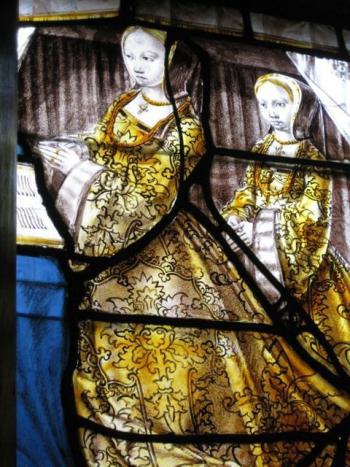 |
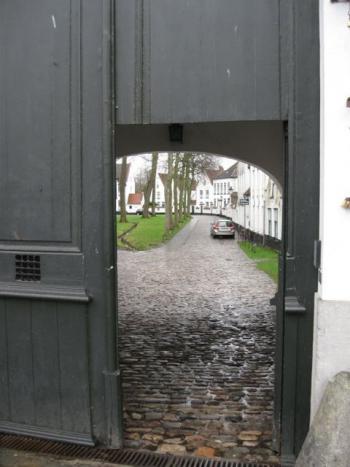
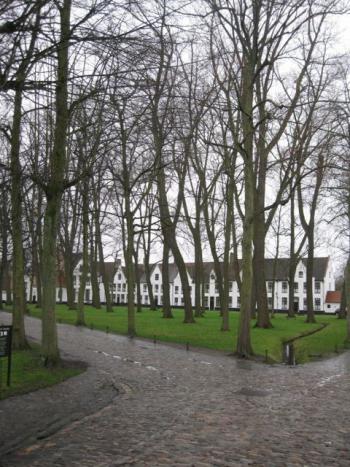
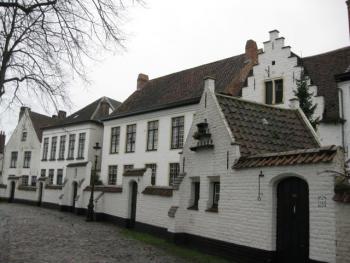
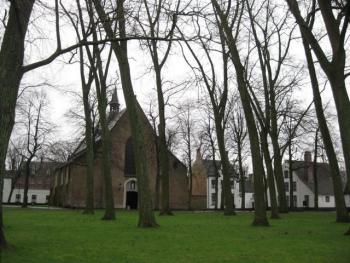
As some of you know, I was traveling in Northern Europe for a couple of weeks in late January and early February. I came upon a couple of walled communities which (of course!) made me think of you all. In Bruges, Belgium, I spent a peaceful morning in a begijnhof (or beguinage), dating from the 13th century, which once housed a Catholic order of single and widowed women, and today is home to Benedictine nuns:
 |
 |
 |
 |
And then, Normandy, I visited the astonishing abbey on Mont St Michel, an island fortress with a cloister strangely reminiscent of--yet different from--Bryn Mawr's:

Reflections: At the Heart of Teaching
I really appreciate reading McEntee et al.'s At the Heart of Teaching--I really appreciate getting a more pragmatic point of view on teaching to coincide with the more theoretical pedagogical discussions we've had on Dewey and Freire (which I also deeply appreciate). I really like how much the writers mention the importance of dialogue among teachers (as well as with individual practice) to take the time to reflect on what happened in the classroom--to really question every action taken, even (especially?) if it was a spur-of-the-moment decision made. From personal experience as a growing educator, this reflection practice has always been invaluable to me to help me focus on specific elements of my practice that need improvement. When I have reflected on these specific things I want to work on, it's almost like I have a new toolbox in my head full of specific tactics I can draw on when I find myself falling back on habits I want to break.

Remote Ready Biology Learning Activities

Remote Ready Biology Learning Activities has 50 remote-ready activities, which work for either your classroom or remote teaching.
What's New? Subscribe to Serendip Studio
A Random Walk
New Topics
-
5 days 9 hours ago
-
5 days 9 hours ago
-
5 days 9 hours ago
-
5 days 9 hours ago
-
1 week 1 day ago
