
Serendip is an independent site partnering with faculty at multiple colleges and universities around the world. Happy exploring!

What to do with technology in the classroom - make it more or less visible?
Last class, we had "goal of education: make technologies more visible" written on the board. I couldn’t help but wonder what would happen if we tried to do the opposite instead. Instead of making technologies more visible, what if we tried harder to integrate them into the classrooms or students themselves as invisible. I'm not so sure that there is a clear answer of which one would be more beneficial, but it’s something interesting to think about.
Making technologies more visible would be directing students to look back on old technologies, some that they take as givens and some that have become seen as outdated, and going back to their sources to seeing what they are missing, what has gotten lost along the way as these old technologies have evolved. Making new technologies less visible would mean integrating them more into the way students learn, think, and exist. It would mean not having to work around the projector screen that is blocking the blackboard, but rather working with it by learning and teaching how to use it well enough that it too becomes invisible.


Another perspective on cyborgs?
Following our class discussion on Andy Clark's ideas and their application to the classroom, I attended my Religion, Sex, and Power class in which we had just read The Cyborg Manifesto by Donna Haraway. Weird coincidence, right? Now, in this other class, we were looking at the concept of a cyborg through a feminist lense and discussing the differences between a cyborg and a goddess, as the auther eventually states that she "would rather be a cyborg than a goddess." How is it, we wondered, that a cyborg is a stronger figure to which women should look than the goddess? After debating for quite a while, we eventually concluded that one imporant aspect of the cyborg is that her inner knowledge is fused with the knowledge of the external world as well (I had to mention the "skinbag" concept at this point....). This contrasts with the image of the goddess that comes from within us and "is us."
Since these two class discussions, I've been trying to think through how some of these contrasts between goddess and cyborg might related to the clasroom. Or do they? One thought I had is that maybe our classrooms should continue to emphasize the activity of reaching outside ourselves and to the larger community to help faciliate our learning and growth.

"Offending Women" certainly offended this woman
I came away from reading the first three chapters of "Offending Women" diametrically opposed to Alliance as a program--with all the unfair, hypocritical, awful practices that were described, I was astounded that Haney was able to remain (relatively) calm and objective about the whole thing as an observer. Frankly, among the young women imprisoned (and I do use the word "imprisoned" intentionally here) by the directors who called these captives "their girls" and presumed to speak of rescuing them, I'm surprised that they were so restrained, that only Maria escaped (so far as Haney reports, if my memory serves). I found Rachel Brennan in particular to be teaching in a way that seemed, after our class discussions of the past few weeks, misguided and even malicious. She taught by and enforced codes that her students were unfamiliar with, that did not fit in with what they wanted in the classroom (being able to keep their children with them, for instance). Her "I know best" attitude and penchant for changing classroom expectations and plans just because she could was infuriating! Her self-congratulatory, smug attitude was counterproductive to listening to her students or improving her techniques, as she was sure that she was teaching her students the value of performing a given task for a monetary reward through her ridiculous, patronizing "Brennan Bucks" program.
Sorry for the rant. I could go on about my frustration with this program, but I'd really like to hear what others have to say, both here on Serendip and in class on Friday.

“Traditional” Ecology: A Field Guide to Flowers
As I made my observations today I found myself wondering about the scientific classifications of the plants I was seeing. I decided that it would be interesting to be a little more informed about the flowers I was looking at.
Using this site as a reference (http://www.mywildflowers.com/) This is what I came up with:
 Flower 1: Great Blanket Flower (Gaillardia aristata)
Other common names: Blanket Flower, Common Gaillardia
Family: Asteraceae (Sunflower)
Height: 2 to 4 ft.
Blooms: July to September
Leaf Type: smooth
Bloom Size: 2 in. (typical)
Flower Description: Individual flowers, Regular blooms, 8 parts
Notes: stems and leaves hairy; petals have 3 tips
 Flower 2: Thin-Leaved Sunflower (Helianthus decapetalus)
Family: Asteraceae (Sunflower)
Height: 2 to 5 ft.
Blooms: August to September
Leaf Type: toothed
Bloom Size: 2 in. (typical)
Flower Description: Individual flowers, Regular blooms, 10 or more parts

は い く
Week 2: observations
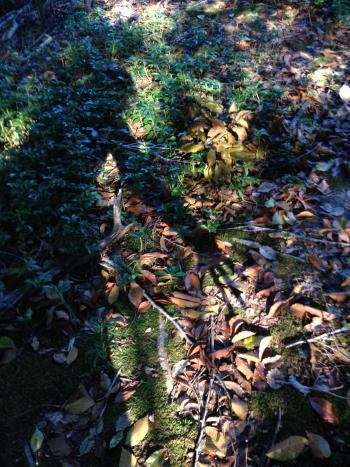
There are some still green
While others have turned yellow
Leaves laying grounded.
The grey covers blue
No light has yet broken through
Morning’s clouded sky.
Wood gently faded
Here sitting amid the trees
Motionless wood bench.
With a nut in mouth
When still, they come next to me
The scampering squirrels.
High boughs releasing
Sharp thud and bounce on the ground
Acorns are falling.
Being still at first
Cool gusts visit, then they are gone
Morning wind blowing.
Silent and yet not
Very few cicadas or birds



DIscovering Dominga
I watched this movie almost 3 years ago when I first visited Guatemala, and it shook me to my core. I know our classes are already really intense and heavy, but I just requested this from Magill at Haverford and if folks want to watch it with me I'd love to have a movie night (maybe this weekend?). As I remember it gives a really good background of the Guatemalan Civil War and why it happened, which I think would be helpful for us to be aware of in our discussions of Rigoberta Menchú.
http://www.pbs.org/pov/discoveringdominga/

Remote Ready Biology Learning Activities

Remote Ready Biology Learning Activities has 50 remote-ready activities, which work for either your classroom or remote teaching.
What's New? Subscribe to Serendip Studio
A Random Walk
New Topics
-
6 days 12 hours ago
-
6 days 12 hours ago
-
6 days 12 hours ago
-
6 days 12 hours ago
-
1 week 2 days ago
