
Serendip is an independent site partnering with faculty at multiple colleges and universities around the world. Happy exploring!

"the gift of privacy with the excitement of participation...choose your spectacle and conserve your soul"
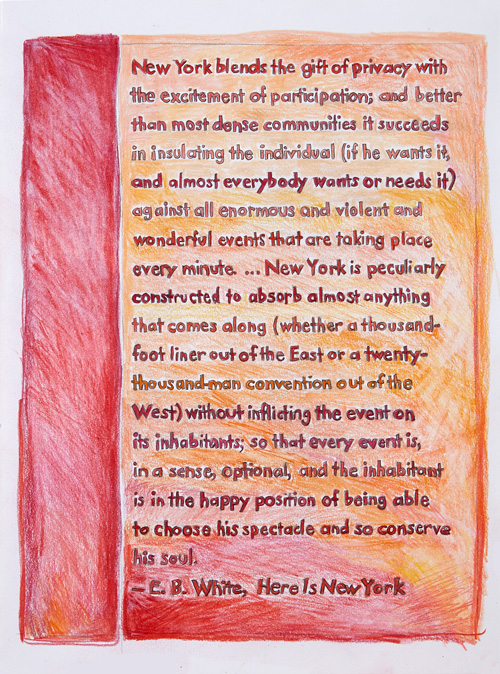
This quotation is taken from E.B. White's classic Here Is New York, rendered into beautiful, colorful typography by Debbie Millman. It says more poetically (and much more positively) what George Simmel "said" to us several months ago: that we cultivate a blasé outlook when we are in the city, because we can't cope with all
the stimulus...

Spirals
It was an upward spiral. Not just for my emotions, but the building I was in. The Solomon R. Guggenheim Museum, designed by Frank Lloyd Wright, is a cylindrical art haven that has the viewer walk up in large spirals to different rooms full of beautiful art. There can be similarities drawn towards the spiral staircase in the Vatican, both in design and spiritual experience. I started my journey, but did not know where it would take me.
The lobby was a little bit crowded, full of people waiting to start their artistic expeditions. Though I was with my family, I knew that this was something I wanted to experience by myself. As I made my way up the first tier, I read the sign that said that the Impressionist painting section was coming up. I paused, took out my headphones, plugged them into my iPod, and began to play Claude Debussy’s beautiful piano pieces. Clair de Lune, Danse Bohémienne, Pagodes – the music these artists were all inspired by. I felt ready to enter the room. I could see how Impressionism worked: the paintings reflected how the music sounded, one small part didn’t seem like much, but altogether it harmonized perfectly.
"Painting come to life"
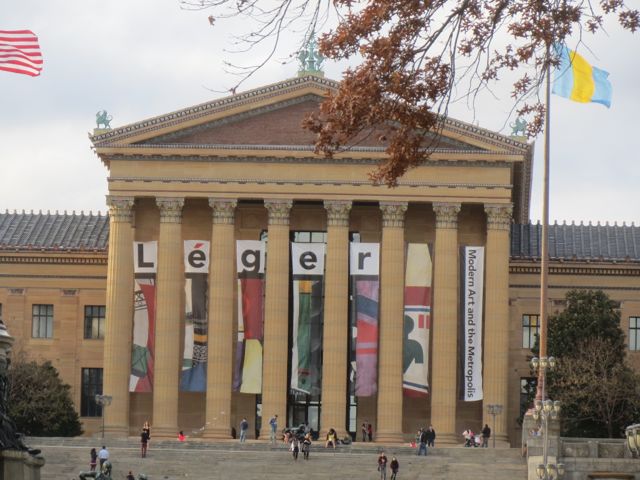
One of the many events Mark and I thought about sending y’all to this semester (and passed over, in favor of other attractions…) was the current exhibit @ the Philadelphia Museum of Art: Léger: Modern Art and the Metropolis. I went to see it this afternoon, really enjoyed it, and thought you might as well (@ least obliquely, and electronically, if not in person).
There’s lots of Duchamp and other Dadaists (which should make us feel right @ home!); Léger was inspired by the “shock of the surprise effect” in their raucous staged events. Léger said that the “task of modern art” was not to simply represent modern life, but to "equal" it; he imagined “color liberated from representation.” There’s lots of motion in these paintings (and Mark, you’ll be interested in particular in a “cine-poem” Léger co-created, “The end of the world filmed by the angel of Notre Dame”--it sounds as though it anticipated Wim Wenders’ work, which you like so much).

Deep Play in the Labyrinth
The summer before my junior year of high school, I went to a weeklong nationwide conference for United Methodist youth groups. There is one thing from that week that stands out in my memory over all else. The second day of the conference, there was a workshop called “Walking the Labyrinth”. I thought this sounded pretty cool, so I got a couple friends together and we went to check it out. It gave the lowdown on what labyrinths were made for, what they were meant to do, and what we should try to focus on while walking through it (which was basically anything that was troubling us). At the time, there was not a whole lot troubling me, so I walked through with nothing specific in mind. But I kept getting worryingly turned around. The point of a labyrinth is that you’re always going a new direction, and not necessarily one that seems to lead to the center. But because of all the other people also walking it, right next to me, I would see them on their own path and think I was walking the wrong way or had somehow stepped off my own path and onto another, and that I wasn’t going to end up going to the middle at all. What if I never reached the center?! I was getting more and more upset until I realized that I had, indeed, been walking on the right path all along and I stepped into the center. I sat down for a while, as we were told to do, to reflect on my experience. I closed my eyes and thought. When I reopened them, I was surrounded by an entirely new group of people.

Great Expectations for a Feminist Workplace
I went to Heidi Hartmann's lecture after class last Tuesday, and she made some similar arguments to the ones she makes in Family First about women in the workplace, advocating for paid family leave, subsidized childcare, and greater work flexibility, for example. These are ideas are as radical as she got. They advocate for very different changes to the current structures of most jobs (and, certainly, expectations of jobs) in the U.S., but Hartmann is still supporting the same structure that is currently in place. Really, most of the changes she proposes are some tweaks that will raise the U.S. up to the same standard as, say, the U.K. in terms of work.

Heidi Hartmann as a power feminist
I thought it was interesting that in class on Thursday we came to conclusion that Heidi Hartmann was a power feminist. I didn’t realize this at the time but one of the questions I had brought with me to Tuesday’s class challenges this idea of power feminism. I was really intrigued my the family first economic policy that would allow for families with newborn children to take time off of work to care for the child without losing a significant amount of compensation. What Hartmann failed to address was how a company would maintain the same level of productivity. Would staff members who are single and without a family have to work extra hours? Would they receive extra compensation for those added hours? Maybe this is a prime example of normative time and requirements for productivity but this seems like a flaw in this economic plan that’s striving for leveling the playing field between men and women. After Thursday’s class and our defining of the term ‘power feminist,’ I realized that this economic plan attempts to create equality by placing an unwarranted burden others who may or may not have the same familial complications.

Deep Play
It’s fall. It is supposed to be cold. Instead, the sun warms us as we sit in the grass. He smiles at me as we reminisce on the beauty of childhood. A kid runs by with a kite, painting shapes in the sky. The child’s parents guide her away from us; I guess it could look sketchy, two teenagers sitting on the edge of woods in a park. But we are literally just sitting there. We’ve been outside for hours, kayaking and walking, and just talking. It’s been so nice to see him. For the first time in a year, he’s come to visit me. We’ve spent the whole day together, and I don’t ever want it to end.

Deep Play In Critical Writing
Samantha Plate
Play In The City
11/17/2013
Deep Play in Critical Writing

Imperialism and incarceration
The other day, I went in to do my internal interview for a big scholarship I'm applying to. For some background, this scholarship is for people interested in public service fields, and I want to be a social worker in the Navy. As expected, I was asked right off the bat "why the military?" and more specifically, why I wanted to be IN the military rather than just work WITH the military.
The answer for me was an easy one: how many times does a person get the opportunity to be a real part of the group that they want to "help"? I feel like I do good work when I go and mentor at Belmont every monday, and I know my mentee really responds to me, but the reality is that I can never be a low-income African-American boy from the city. This is not an identity I share. I know that my inability to relate to him on this most fundamental level means that I can never really be the most effective mentor. I'm missing that level of empathy, and I don't know exactly what he needs. The military represents an opportunity, though. Finally I can avoid the trap that is professional imperialism and serve the population of the military because not only do I know the unique stressors and challenges they face, but because I face them, too.
Of course, this would have been the answer I'd have given in a perfect world, or with interviews whose goal was not to push my thinking. So instead my answer went something more like: "...want to try and avoid stepping into a population and doing my best to help the way I think is ri---"

Power feminism & economic adjustment of languages
Last class, we met in our groups and tried to come up with an economic approach to whatever topic we had chosen for our web event, and having chosen gendered pronouns, I struggled for a while trying to figure out a practical application. After talking it out with one of my partners, though, she helped me realize that a business-centered pronoun could potentially solve the issue. If you use a pronoun unrelated to either gender (possibly deriving from pre-existing gender-neutral pronouns), the terms come without any subconscious connotations, then until one is face-to-face with the individual, there's a preconceived notion of how they operate their business. And even then, using identical pronouns can force the speakers into operating on a subconscious equal playing field across genders, stemming from the idea of male pronouns being action takers (and a point I didn't realize until after the fact, female pronouns being applied to possession - ships and cars - while stereotypically female jobs like secretaries and nurses are seen as subservient to male positions).

Remote Ready Biology Learning Activities

Remote Ready Biology Learning Activities has 50 remote-ready activities, which work for either your classroom or remote teaching.
What's New? Subscribe to Serendip Studio
A Random Walk
New Topics
-
4 days 4 hours ago
-
4 days 4 hours ago
-
4 days 4 hours ago
-
4 days 4 hours ago
-
1 week 3 hours ago
